Bitcoin’s Hype Cycle

By Eli Afram
May 12, 2017
In 2016, Zafar Khan, CEO of RPost, wrote a fascinating article concerning Bitcoin’s price movements and its correlation to Gartner’s Hype Cycle. Mr Khan noted that in late 2013, a hype cycle began which quickly materialized into a major bubble, reaching extraordinary heights, before crashing back down. The ‘crash’ however didn’t quite bring Bitcoin back to the same price it had been prior to the hype cycle. In fact, the price generally remained well above what it had been prior to this hype cycle.

This hype cycle had already occurred twice before in Bitcoin’s history, with an almost identical chart pattern each time. The first ‘bubble’ in July 2011 reached $31 USD. Two years later, a second price bubble reached $266 USD. Not too long after, Bitcoin experienced a major price bubble which saw the price reach $1242 USD.
Now we are literally experiencing a fourth bubble. It is important to note that each time each “bubble” has dwarfed the previous in comparison, and this one is looking to be no different. In fact if we follow the ratios of increases against the timeline, this rally could very well see the price reach anything from $4000 to $6,000 USD. But as I have mentioned many times in the past, “correlation does not equal causation”, and when markets are involved, anything can and does happen. This “unknown” factor that crashes markets is referred to as a ‘Black Swan’ event – a phrase made famous by statistician Nicholas Taleb.
But regardless it is interesting to take note of what is actually causing these ever inflating hype cycles. The answer is two pronged. On one hand we have the ever growing popularity of Bitcoin, which is now seeing the involvement of billionaire investors, and on the other hand the drying supply curve of minted coins.
At the first hype bubble the mining reward was at 50 Bitcoins per block. Today the mining reward is only at 12.5 Bitcoins per block. This means that only a quarter of the original minting supply is coming in to today’s eco-system.
The real intriguing point is that Bitcoin continues to grow in the face of much negative publicity, and decreasing payment utility. Transaction fees are at all-time highs, making small payments on the network absolutely non-viable. Instead, Bitcoin’s utility is seeing a major shift, and is being perceived more as a safe store of value, as opposed to a common payment system.
Today, Bitcoin is the most secure, safest store of value among all crypto-currencies. At the time of writing, Bitcoin’s Hashrate stands at a whopping 4,023,560,568 GH/s. It is virtually impossible to attack.
With both increasing popularity and increasing scarcity, Bitcoin’s hype cycles may very well remain a growing, recurring, fact of the system.
The bitcoin hype is weird. But investors might be right.
In the long history of money, there have been essentially two kinds. The first is a tangible commodity — usually, gold. The second is a “fiat currency,” created by a ruler with the power to compel use. The proposition underlying this year’s extraordinary bitcoin surge is that we are about to have a third type of money. It is abstract, not tangible; it is the brainchild of a computer scientist with no power to compel anything. Today’s leading creators of money — the Federal Reserve, the European Central Bank — are at pains to appear transparent and accountable. In contrast, bitcoin’s creator is silent and anonymous.
It is possible, theoretically, that the bitcoin backers are right. Just because something has never existed does not mean it cannot exist. And if enough people believe in bitcoin, their conviction will be self-fulfilling. In a lucid comment, Silicon Valley entrepreneur Auren Hoffman suggests that, if bitcoin comes to be accepted as a safe long-term store of value, demand from savers might drive its price up a hundredfold — on top of the 16-fold price surge witnessed this year. Even if you think the odds of this happening are only around 10 percent, the potential reward is so juicy that you might take the bet — and so help to make the bet come good.
But none of this alters the reality that the bitcoin hype is weird. To succeed as a store of wealth, money usually has to be a transactions medium — after all, wealth is only meaningful if you can use it to buy stuff. But bitcoin is touted as a store of value even though, with a few minor exceptions, you can’t exchange it for items of value. If I stored my wealth in air miles — a privately issued form of money that is significantly more useful than bitcoin — you might suspect that the tedium of airport security lines had addled my judgment.
Bitcoin believers say it can flourish as a pure store of value, without being a medium of exchange. People who think central banks are liable to generate inflation can protect their savings by holding bitcoin, according to this theory; then, when they want to spend some, they can convert the bitcoin into dollars. But this vision ignores the way finance operates. In order for there to be an easy way of swapping bitcoin into dollars, there has to be vigorous flow of trades in both directions — otherwise, the transaction costs will be daunting. A currency that is a long-term store of value and not a transaction medium won’t generate much trading. People will be stashing it in their digital mattresses, not buying and selling.
Besides, the need for bitcoin as a store of value is not at all clear. Despite the enormous shock of the 2008 meltdown and the extraordinary money creation that followed, the dollar has proved itself to be an excellent store of value. The annual rate of core inflation — that is, the change in the dollar’s purchasing power, excluding volatile food and energy prices — has plodded along between 1.2 and 1.9 percent since the crisis; if you add in food and energy, post-crisis inflation has never exceeded 3.2 percent. In contrast, bitcoin’s value swings alarmingly, even if most of the gyrations have been upward. From June through September, it suffered through two periods in which its price fell by a fifth in less than a month. A store of value that fails to store value is a curious idea.
Bitcoin is often described as digital gold. The enduring appeal of gold to a small but fervent cadre of investors does indeed show that there is a hankering for a store of value beyond the reach of governments. But gold’s appeal is built on two advantages. It has a track record going back centuries, and its sheer physicality is psychologically appealing when wealth consists of little more than numbers on screens. In the chaos after 2008, I met a hedge-fund manager who held ingots in Zurich. Come the apocalypse, he would somehow make his way to Switzerland and take solace in riches that you can drop on your foot.
Unlike gold, bitcoin has no pedigree, and it is even more abstract than mainstream currencies. But its appeal is built on something different. It basks in the excitement that surrounds all things technological: Everything from transport to the news business is being disrupted, so why not money? The bitcoin bonanza mirrors the extraordinary run-up in tech stocks more generally, with the difference that the usefulness of Amazon or Google is a lot more obvious. When you cut through all the hype, bitcoin is a technology that invites speculators to bet on the promise of technology. If it sounds a little dicey, that’s because it is.
Bitcoin Hype: Very Different to Tulip Mania

7 min read / December 26, 2017
As Bitcoin and the rest of the cryptocurrency market continue to rise, an increasing number of critics have compared this meteoric surge with the Tulip Mania that gripped the Dutch Republic in the early 17th century. There is no doubt that the current boom which is being seen across most cryptocurrencies is a bubble, but it is not one comparable to the Dutch situation.
Cryptocurrency Boom
Bitcoin was invented in 2009 by a person or group under the alias Satoshi Nakamoto as a decentralised, “peer-to-peer version of electronic cash.” Bitcoin transactions are completely traceable, and every single transaction is public; however, the ledger only records the wallets that money is being sent to, and it is possible to create a wallet without your identity being verified.
The total number of Bitcoins is capped at 21 million, with nearly 17 million in circulation today. Transactions on the network are approved by a process known as mining on people’s computers, and the original price was based on the cost of the amount of electricity then needed to mine. This meant that the initial rate of exchange of Bitcoin was US$1 = 1,309.03 BTC.
More cryptocurrencies have been invented since then, with Litecoin being established in 2011, Ripple in 2013 and Ethereum in 2015. These are just some of the now over 1,300 cryptocurrencies on the market, and there are more created with every fork or Initial Coin Offering (ICO).As interest in the coins and the underlying blockchain technology has increased, the prices have risen astronomically. One Bitcoin is currently priced (at the time of writing, on Boxing Day) at $14,100 – this is an increase in price such that a $1 investment in Bitcoin in 2009 is now worth $18.5m.
These are the kind of returns that continue to attract investors, and it is the steady influx of new investors pumping money into cryptocurrencies which has seen the total market capitalisation surpass $650bn. Bitcoin is now the largest bubble in history, and the whole cryptocurrency market is highly inflated at present. However, this is not as similar to Tulip Mania as many commentators suggest.
Tulip Mania
The Dutch Republic in the 1630s experienced the first recorded speculative bubble in history. Tulips had only recently arrived in Western Europe and were highly sought after due to their beautiful vivid colours and intricate patterns. The small supply and increasing demand naturally led to surging prices at the time. Investors began to speculate on the price of the tulips that had not yet flowered and sign contracts to buy tulips in future months. At the peak of the bubble, a single bulb was sold for over 12 acres of land, and there are stories of people selling their houses to buy one. In early February 1637, the bubble burst, and within a few months, the price was back to its original levels.
It is one of the most widely used examples when people talk about asset bubbles, thanks to both the ‘obvious’ absurdity of selling your house for a flower and the huge, rapid price change in the goods concerned. Hence Jamie Dimon, CEO of JP Morgan, has said that Bitcoin is “worse than tulip bulbs”, and other investors have increasingly likened it to the current cryptocurrency situation.
Bitcoins are not Tulips
Tulip Mania is a perfect example of speculation driving prices to absurd levels as the flowers have barely any intrinsic value. Applying the same principle to Bitcoin is debatable at best, as many believe the cryptocurrency could become an electronic store of value, much like gold is a physical store of value. Both Bitcoin and gold are durable, scarce, fungible and divisible, whereas tulips are not. Most importantly there are ways of calculating a fundamental value for Bitcoin, such as the ones mentioned in this article, which do not make far-reaching assumptions to help validate its current valuation.
Secondly, the tulip bubble happened over a significantly short period of time, with the most price growth occurring within the space of 3 or 4 months before it peaked. In comparison, Bitcoin’s price has been growing for almost 7 years now, despite some small crashes along the way.
Lastly, the bubble that society is seeing right now is not just about Bitcoin – nearly all cryptocurrencies are seeing huge gains in short periods of times with arguably no changes to their fundamentals. This is significant as, although there were bulbs with different colours and patterns during Tulip Mania, the goods were essentially homogeneous. In the cryptocurrency world right now, there are over 1,300 different coins.
While many are similar, most coins are designed with different purposes in mind. For example, Ripple is aimed at reducing fees and the speed with which banks process payments and transfers, and ECO Coins hope to reward sustainable activity and lead to a more environmentally friendly world. Instead, this bubble should be compared to another which also had differentiation within the goods concerned and where some of them arguably had intrinsic value.
The Dotcom Bubble
In the 1990s, as access to the internet and computers for personal use began to rapidly increase, the number of companies based online exploded. The bubble lasted between 1995 and 2000, with the Nasdaq Index increasing by 500%, one of the largest stock runs in history. At its height in 1999, there were 457 IPOs, of which 117 doubled in price on their first day of trading. The number of internet companies going public and their respective market capitalisation was huge, and was propelled by the potential for the technology to change lives. The problem was that any company related to the internet then became sought after, even if they did not have a credible business model.
This is rather similar to what society is seeing with the cryptocurrency boom at the moment. There is no doubt that blockchain and the distributive ledger technology is revolutionary and can lead to improvements in many different aspects of our lives. However, there are some coins in the current cryptocurrency market which do not offer anything ‘special’ – they are simply a mixture of different coins and do not solve an existing problem. Many of the price increases seen in these coins are just because investors are looking for the ‘next Bitcoin’ and quick returns – which is reminiscent of the dotcom bubble.
This is not to say that all the coins serve no long-term purpose; Substratum is hoping to decentralise the internet for users in countries with heavy restrictions on content access by letting users offer their computing power for coins and allowing others to surf the web freely. This is likely to become particularly useful now that web neutrality laws are being taken away in the US and China has recently banned VPNs bypassing the ‘Great Firewall’. This makes it much like the dotcom bubble, where many companies had little value, but some companies such as Cisco, Google and Amazon thrived in the long-term. This is despite share price drops of over 90% when the bubble burst, showing that even though they were inflated during the bubble, they have since recovered and are now some of the largest companies in the world.
Conclusion
In conclusion, people should stop likening the current Bitcoin and cryptocurrency bubble with ‘Tulip Mania’. The variety of the products within the bubble, the sustained price growth over many years and most importantly the revolutionary technology underlying it suggests that it should instead serve as a comparison to the 1990s dotcom bubble.
Have your say. Sign up now to become an Author!
Is Bitcoin Worth the Hype? Experts Sound Off
WASHINGTON – At the ShmooCon hacker conference here this past weekend, two security experts went head-to-head over Bitcoins and other cryptocurrencies. The debate quickly devolved — or evolved, depending on your point of view — into Gilbert-and-Sullivan-style light verse.

"The concept of cryptocurrency is really quite extraordinary," began Jack Gavigan, chief operating officer of the Zerocoin Electric Coin Company, who had been assigned the anti-cryptocurrency side despite his day job. "But the value of a coin seems to be entirely arbitrary."
Despite the constant jokes, the conclusion was that even though prices may be volatile, the interest in cryptocurrencies was fueling valuable research into financial technology and cryptography.
I am the very model of a modern Bitcoin blockchain
The normally skeptical Jack Daniel, a veteran hacker who had augmented his normal wizardly appearance – tall with a long white beard – with a monk's robe, argued the pro-cryptocurrency side.
Gavigan, an information-security expert with an MBA who used to trade for Morgan Stanley and now manages the Zcash cryptocurrency, had rightly guessed that he'd have to debate against his own means of making a living. He came armed with 32 lines of rhyming patter.
"When people try to justify the price, the logic isn't there," he said. "It feels like all they're doing is creating money out of thin air."
"Wait a second," said debate moderator and ShmooCon co-founder Bruce Potter. "Are you debating in verse?"
"In theory, Bitcoin should be great for making payments peer-to-peer," continued Gavigan, not looking up. "Cutting out the banks and middlemen meant it shouldn't be as dear. But while that's great in theory, in practice that's not true. You have to pay huge transaction fees to get your payment to go through."
"The Bitcoin Lorax speaks!" someone shouted from the crowd.
Gavigan went on for six more stanzas, and received a standing ovation at the end of the last: "In conclusion, whether you think that cryptocurrency is good or bad, the question we must address is 'Is it the future, or just a fad?' The answer will make the Bitcoin fans hot under the collar. But for now, it's clearly safer to stick with the good old U.S. dollar."
But in all serious, cryptocurrency has some value
It would have been difficult for anyone to reply to that, but Daniel made a good show of it. He pointed out that arguments about the volatility of cryptocurrencies could just as easily apply to more traditional forms of investment.
"Bitcoin is not the only way to lose money," Daniel said. "Anyone here buy a house in Las Vegas or South Florida 15 years ago? How'd that work out? There is volatility in everything."
He argued that while Bitcoin itself may not succeed, he said that its current notoriety ensured that "we're learning things — how to make a distributed trust model, how to make blockchain actually useful."
"The world is more global than ever, but our traditional currencies don't reflect that. Cryptocurrency gives us a global currency, and it is the future," Daniel concluded.
Wendy Nather, another well-known information-security expert who now works at Duo Security, jumped in to recommend a skeptical book called "Attack of the 50-Foot Blockchain." She lampooned blockchain advocates who say the technology is the magic solution to all sorts of problems.
"There are scams and Ponzi schemes, but what if we just put people on the blockchain?" she asked. "There will be no room for mistakes and error. Then we'll have cured cancer."
Will governments step in?
Someone in the audience asked if governments might start creating their own cryptocurrencies.
"What they're all looking at is putting fiat currency on a blockchain," Gavigan replied in seriousness, adding that cryptocurrency makes it easy for a person living in one country to send money to a person living in a different country with a different unit of currency.
"We already have a mature economy with an abstraction layer, a credit card, that takes care of currency conversion for you," countered Daniel. "If I go to Norway, I don't have to convert dollars into the local currency — I just put everything on a credit card."
"There are other ways to have electronic transfer of cash without a middleman" than cryptocurrency, Potter said in support of Daniel's point.
Bottom line
Overall, it seemed that the pro-cryptocurrency argument had won out. Daniel's debate points in favor of cryptocurrencies, despite being insincere, were valid.
Potter pointed out that many of the flaws that Gavigan noted in his anti-cryptocurrency poem referred to Bitcoin specifically, and had been resolved in Gavigan's own cryptocurrency, Zcash. (Even Edward Snowden has weighed in on behalf of Zcash.)
And no one could really dispute that cryptocurrency was fascinating, and was making us think about the ways we devise and control money.
"Cryptocurrency is funding research into this space, and into cryptography itself," Gavigan said.
Bitcoin hype leads more to ask: what is blockchain?
Listen to this article
Give us your feedback Thank you for your feedback.
What do you think?
- I‘ll use it in the future
- I don‘t think I‘ll use it
It is a technology so new that many people in finance cannot explain what it is or what it might be able to do — yet they know they might have to worry about it.
Demand from professionals for learning about blockchain, the technology that powers the virtual currency bitcoin, is so great that Cambridge university plans to offer courses to executives about its disruptive potential this year.
Blockchain has been the subject of a significant amount of hype over the past year as institutions ranging from banks, exchanges, insurers and governments have rushed to work out how blockchain could be used, by them or rivals. The technology deployed is known as a distributed database, which runs from many computers and needs no central authority.
Cambridge’s Centre for Alternative Finance, based at its Judge Business School, will be the first in the UK to teach the subject, with demand coming mainly from employees of global banks.
“Nobody wants to be Kodak,” says Robert Wardrop, executive director of the school’s centre for alternative finance, comparing the film-maker’s failure to adapt to the digitisation of photography to the change in the banking sector.
“They [bankers] all know their industry is being digitalised, how you develop a competitive response . . . that is the challenge,” Mr Wardrop says. “Do you do nothing, collaborate or compete?”
Advocates believe that though blockchain is at an early stage in its development, it has the potential to disrupt many sectors. This is because it is transparent, indelible and tamper-proof and is jointly run by several parties. It could be used to keep records such as on a person’s complete health or insurance history, for example. Or it could be used for cross-border clearing and settlement.
Cambridge’s teaching about blockchain and digital currencies will be a core part of its educational programme on fintech, which is being developed by the Centre for Alternative Finance. Professors will also cover peer-to-peer lending, crowdfunding, alternative investments and new forms of credit analytics. The material will be included in the university’s master of finance programme this summer.
The introduction of the Cambridge course comes after several US universities that had added bitcoin to their syllabuses in 2014 shifted their attention to blockchain.
David Yermack, a professor of finance at New York University’s Stern School of Business, says there is great interest in the quandaries posed by emerging technology to regulators. “There are huge challenges for most governments around the world because they assume the current law will deal with a lot of blockchain issues,” he says. “But it is a totally different animal.”
Professor Yermack predicts that a technological evolution will shrink the size of the industry’s workforce overall, but in doing so it will create many specialist tech jobs.
[Bankers] all know their industry is being digitalised, Do they do nothing, collaborate or compete?
Stern School will teach its MBA students about digital currencies, blockchains and their growing place in the financial services industry from next spring. It also plans a course for executives. At Duke University’s Fuqua School of Business, emphasis has also shifted away from bitcoin. Duke says its innovation and cryptoventures course, which is part of the MBA, has been heavily oversubscribed and is aimed at students who want to create their own blockchain start-ups. Campbell Harvey, finance professor at Fuqua, says: “Now it’s the general technology called blockchain. There are apps that go with it, bitcoin is one of them.”
Universities are mostly teaching the basics of blockchain: the context of how the technology came about, its mechanics and how people are trying to commercialise and innovate with it.
Garrick Hileman, who teaches blockchain and virtual currencies at Cambridge, says that for more than two years he has seen “tremendous” interest from companies. He has been called in to teach executives informally about bitcoin and other virtual currencies such as ether, and more recently, blockchain. “Many people are still trying to understand the basics,” he says.
Blockchain’s reputation has suffered from its association with bitcoin, which has been tarnished by the collapse of Mt Gox — a prominent exchange, with the disappearance of $500m worth of customers’ bitcoins — and the closure by US authorities of the Silk Road website, which facilitated the sale of illegal drugs.
But part of what attracted executives to the potential of distributed databases was seeing how well bitcoin performed as it attracted users around the world. Launched in 2008, bitcoin’s market value now stands at more than $10bn, according to Coindesk, which tracks bitcoin data.
While the new Cambridge course will teach key concepts — such as what blockchain is and how it is being experimented with — it will not go in depth into the complex cryptographic processes that would be more suited to a computer science course.
Manfred Alfonso Dasenbrock, an executive at Brazilian co-operative Sicredi, who attended a fintech course at Cambridge in September, says: “The way we do banking business will not be the same in a few years.”
US Search Mobile Web

Welcome to the Yahoo Search forum! We’d love to hear your ideas on how to improve Yahoo Search.
The Yahoo product feedback forum now requires a valid Yahoo ID and password to participate.
You are now required to sign-in using your Yahoo email account in order to provide us with feedback and to submit votes and comments to existing ideas. If you do not have a Yahoo ID or the password to your Yahoo ID, please sign-up for a new account.
If you have a valid Yahoo ID and password, follow these steps if you would like to remove your posts, comments, votes, and/or profile from the Yahoo product feedback forum.
- Vote for an existing idea ( )
- or
- Post a new idea…
- Hot ideas
- Top ideas
- New ideas
- Category
- Status
- My feedback
Improve your services
Your search engine does not find any satisfactory results for searches. It is too weak. Also, the server of bing is often off
I created a yahoo/email account long ago but I lost access to it; can y'all delete all my yahoo/yahoo account except for my newest YaAccount
I want all my lost access yahoo account 'delete'; Requesting supporter for these old account deletion; 'except' my Newest yahoo account this Account don't delete! Because I don't want it interfering my online 'gamble' /games/business/data/ Activity , because the computer/security program might 'scure' my Information and detect theres other account; then secure online activities/ business securing from my suspicion because of my other account existing will make the security program be 'Suspicious' until I'm 'secure'; and if I'm gambling online 'Depositing' then I need those account 'delete' because the insecurity 'Suspicioun' will program the casino game 'Programs' securities' to be 'secure' then it'll be 'unfair' gaming and I'll lose because of the insecurity can be a 'Excuse'. Hope y'all understand my explanation!
I want all my lost access yahoo account 'delete'; Requesting supporter for these old account deletion; 'except' my Newest yahoo account this Account don't delete! Because I don't want it interfering my online 'gamble' /games/business/data/ Activity , because the computer/security program might 'scure' my Information and detect theres other account; then secure online activities/ business securing from my suspicion because of my other account existing will make the security program be 'Suspicious' until I'm 'secure'; and if I'm gambling online 'Depositing' then I need those account 'delete' because the insecurity 'Suspicioun' will program the casino game 'Programs' securities' to be… more
chithidio@Yahoo.com
i dont know what happened but i can not search anything.
Golf handicap tracker, why can't I get to it?
Why do I get redirected on pc and mobile device?
Rahyaftco@yahoo.com
RYAN RAHSAD BELL literally means
Question on a link
In the search for Anaïs Nin, one of the first few links shows a picture of a man. Why? Since Nin is a woman, I can’t figure out why. Can you show some reason for this? Who is he? If you click on the picture a group of pictures of Nin and no mention of that man. Is it an error?
Repair the Yahoo Search App.
Yahoo Search App from the Google Play Store on my Samsung Galaxy S8+ phone stopped working on May 18, 2018.
I went to the Yahoo Troubleshooting page but the article that said to do a certain 8 steps to fix the problem with Yahoo Services not working and how to fix the problem. Of course they didn't work.
I contacted Samsung thru their Samsung Tutor app on my phone. I gave their Technican access to my phone to see if there was a problem with my phone that stopped the Yahoo Search App from working. He went to Yahoo and I signed in so he could try to fix the Yahoo Search App not working. He also used another phone, installed the app from the Google Play Store to see if the app would do any kind of search thru the app. The Yahoo Search App just wasn't working.
I also had At&t try to help me because I have UVERSE for my internet service. My internet was working perfectly. Their Technical Support team member checked the Yahoo Search App and it wouldn't work for him either.
We can go to www.yahoo.com and search for any topic or website. It's just the Yahoo Search App that won't allow anyone to do web searches at all.
I let Google know that the Yahoo Search App installed from their Google Play Store had completely stopped working on May 18, 2018.
I told them that Yahoo has made sure that their Yahoo members can't contact them about anything.
I noticed that right after I accepted the agreement that said Oath had joined with Verizon I started having the problem with the Yahoo Search App.
No matter what I search for or website thru the Yahoo Search App it says the following after I searched for
www.att.com.
WEBPAGE NOT AVAILABLE
This webpage at gttp://r.search.yahoo.com/_ylt=A0geJGq8BbkrgALEMMITE5jylu=X3oDMTEzcTjdWsyBGNvbG8DYmyxBHBvcwMxBHZ0aWQDTkFQUEMwxzEEc2VjA3NylRo=10/Ru=https%3a%2f%2fwww.att.att.com%2f/Rk=2/Es=plkGNRAB61_XKqFjTEN7J8cXA-
could not be loaded because:
net::ERR_CLEARTEXT_NOT_PERMITTED
I tried to search for things like www.homedepot.com. The same thing happened. It would say WEBPAGE NOT AVAILABLE. The only thing that changed were all the upper and lower case letters, numbers and symbols.
Then it would again say
could not be loaded because:
net::ERR_CLEARTEXT_NOT_PERMITTED
This is the same thing that happened when Samsung and At&t tried to do any kind of searches thru the Yahoo Search App.
Yahoo needs to fix the problem with their app.
Yahoo Search App from the Google Play Store on my Samsung Galaxy S8+ phone stopped working on May 18, 2018.
I went to the Yahoo Troubleshooting page but the article that said to do a certain 8 steps to fix the problem with Yahoo Services not working and how to fix the problem. Of course they didn't work.
I contacted Samsung thru their Samsung Tutor app on my phone. I gave their Technican access to my phone to see if there was a problem with my phone that stopped the Yahoo Search App from working. He went to Yahoo and… more
Watch And Learn: Bitcoin, The Hype And The Bubble

It is seldom justified to speak about a bubble, rally or a crash. In the case of Bitcoin and cryptocurrencies, all these phrases might be understatements.
Bitcoin and other cryptocurrencies are difficult to understand, but interesting and have the potential to excite people - a perfect combination for inflated expectations.
As always, the mass media is important for the information reaching a large crowd and condition for Bitcoin prices to rally.
Finally, the fear of missing out, the challenging of valuation metrics and new era thinking lead to confirmation bias and extreme asset prices creating maybe the worst bubble ever.
Bitcoin (COIN) (OTCQX:GBTC) is presenting a great story right now as it has all the important ingredients to create noteworthy headlines. In only 30 trading days, Bitcoin (compared to the USD) has lost nearly 50% of its value and such a steep decline is justifying to use phrases like "crash" or "meltdown" - words that create attention. If it was the US stock market that lost 50% of its value within only 30 trading days, I am sure I would read articles about the world ending. But under the conditions of a bubble, such a steep decline can be rephrased and is only a temporary setback and a one-in-a-million buying opportunity. And there we have another buzzword that is used way too often: bubble. All these words like bubble, rally or crash are widely used by authors who write about the stock market because they create attention (I am hardly an exception). We are all using these words way too thoughtless, but with Bitcoin (and other cryptocurrencies), all these words are justified and in no way an exaggeration. Bitcoin is a textbook example of a bubble and an excellent chance to study how such bubbles are created. According to Gartner, it takes three steps in the hype cycle until the peak of inflated expectations is reached and the bubble will pop. The following article is structured in three sections following the three steps described by Gartner.
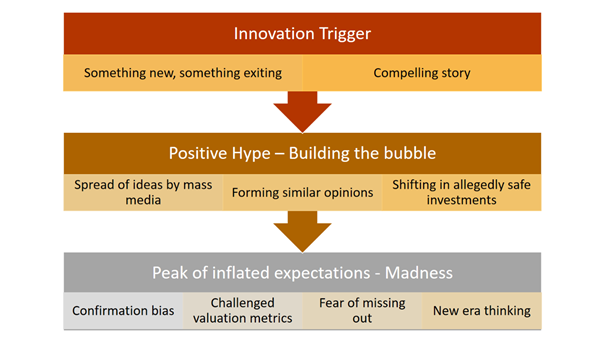
Part I: Innovation trigger and premises
Not every new technology is creating a massive hype and not every tradeable asset is creating a bubble. In the first stage, only a few selected people know about the new invention or the new technology. These guys are usually experts in a field and probably work in the research and development department or are scientists. Additionally, we have a few other people that are interested in the new technology. At that point, an overwhelming majority of the world population has never heard about the new invention and if someone would tell them, they would find it extremely boring, they wouldn't care and probably understand nothing about the technology. But already at that early stage, the asset has a few characteristics that seem to be necessary to create a bubble as not every asset class seems suitable for inflated expectations at any time.
Something new, something exciting
Humans are usually attracted by new objects, new locations, new places - it is not the known and familiar that is fascinating for us, but the unknown and new. We are drawn towards new innovations and technologies because they are fascinating for us. Technologies that have been around for decades can hardly get people as excited as the new inventions. Nevertheless, it may take some time before a new technology might create a hype: the internet existed already a few years before the dotcom bubble occurred, and Bitcoin also existed since 2009 and the price has already seen a few "small bubbles", but it took until 2017 to enter full madness.
Compelling story
For the new technology to provide a compelling story, some criteria have to be met. An asset bubble can only occur when expectations about the value of an asset can reach astronomical levels as the price of an asset (whether it is gold, stocks or currencies) always reflects these future expectations. The technology, therefore, should have the potential to alter people's lives sustainable - at least in people's imagination - because this is the basis for inflated expectations. The technology should have the potential to get people excited and tickle everybody's fancy about changing the world. Although nobody is writing about the new technology or asset yet, it has to be exciting and newsworthy and providing the opportunity for great stories that can be picked up by the mass media.
On the one hand, the technology should be complex and rather difficult to understand. This provides the perfect soil for crazy fantasies. If one can't see clearly what a new technology can accomplish and what not, it provides the possibility to fantasize in crazy ways about. On the other hand, especially today with Twitter (NYSE:TWTR) and similar social media platforms which don't really support long and complicated articles, it should have the potential to be described in just a few words (even if this means a drastic reduction in complexity that doesn't meet the standards of describing the technology at all).
Part II: Building the bubble
We have to understand that the people interested in the technology in the first place are seldom the people interested while the technology goes through its hype and the underlying asset is creating a bubble. Those interested in the technology at the beginning are the ones understanding the technology and trying to develop and making it better and they are seldom interested in making a fortune. But then we can witness a shift from those people that are truly interested in the technology and understand it towards those people that are solely interested in getting rich and see the underlying asset just as a way to do it but don't care about the technology at all.
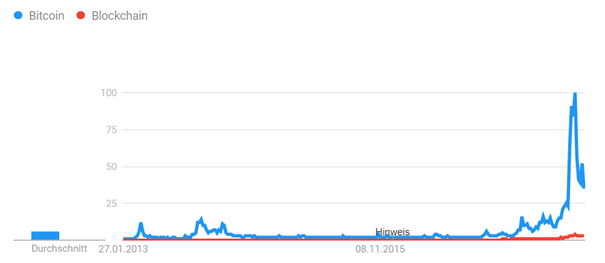
I think the search volume for Bitcoin and Blockchain compared is showing how those who were interested in the technology (Blockchain) are replaced by the gamblers and speculators that are just interested in the asset (Bitcoin). But for that shift, a few steps have to be taken.
Spread of ideas by mass media
A bubble requires market participants buying a certain asset and pushing the prices higher and higher. In a first step, people have to be aware of a certain asset, and therefore, we need constant reports about the asset to get many people's attention. I assume that many people outside the financial market didn't hear about Bitcoin or cryptocurrencies until a few months ago. "Significant market events generally occur only if there is similar thinking among large groups of people, and the news media are essential vehicles for the spread of ideas." (Shiller, p. 71). The history of bubbles begins roughly around the 1630s with the Dutch tulip mania and it is no coincidence that the advent of newspapers falls in the same time (see Shiller, p. 71). A bubble, however, doesn't require newspapers in particular - radio, television or Twitter and Facebook (FB) work just as well. It is irrelevant how the information is distributed - it is only important that the information reaches a very large crowd. Google is of course just one way to search for information, but it shows very impressively how interest in "Bitcoin" has exploded in the second half of 2017 - exceeding other investment topics like gold, USD or the stock market in general.
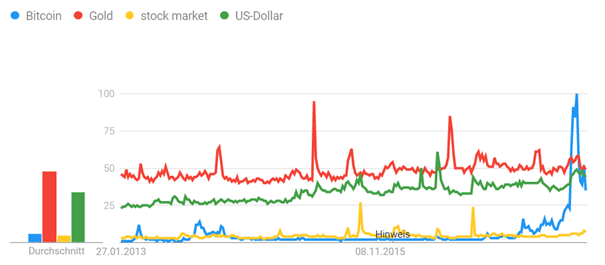
However, it is not just the Google search volume for Bitcoin that increased extremely - the number of tweets also increased from about 20,000 in the end of 2016 to about 150,000 in December 2017.
Forming similar opinions
But it is not enough if a lot of people are searching for a certain topic and if that topic is suddenly popular due to massive media coverage. People not only have to be aware of an asset but also form a similar (bullish) opinion about the asset - otherwise, a bubble is not possible. If a few people assume that the asset should be worth much more and some others have the opinion it should be worth less, there won't be a bubble. Usually, people can have many different opinions about a certain topic, but for financial assets, it is very easy to categorize in only three groups - those that are indifferent, the bulls expecting higher prices, and the bears expecting lower prices. I am aware that this categorization is an over-simplification of facts, but compared to other topics, it is quite easy to categorize opinions about financial assets and this is supporting the existence of strong sentiments that many people fall for without calling the bullish (or bearish) opinion into question.
Shifting in allegedly safe investments
A third and final aspect that is not really a condition for a hype but can often be witnessed when bubbles occur is the piling into new investments after the investment in another asset has gone dramatically wrong. In many cases, there has been a bubble before and after that bubble busted investors fled in "safer" investments creating another bubble. After the dotcom bubble burst, investors shifted to the housing market as stocks were considered as too risky and created the housing bubble, that lead in consequence to the financial crisis. After the financial crisis with all its horrible consequences of quantitative easing and the dwindling trust in the monetary system, investors now seem to be eager to move away from established currencies to "safer" cryptocurrencies that can't be deflated and will allegedly solve many problems.
Part III: Crazy time
With media constantly reporting about the new technology plus many people forming a similar opinion about the asset, we enter the final stage of the bubble and build up towards the peak of inflated expectations. It is not really clear how long this phase can last - maybe a few months or several years. One would have to assume that this final stage will be over after a few months, and the hype will soften again. However, we are dealing with a vicious cycle and events reinforce themselves. Financial markets are an extremely complex system, and therefore, we experience feedback loops and characteristics of self-fulfilling prophecies. Some of the events and characteristics that reinforce themselves are people challenging valuations, the fear of missing out, new era thinking, and confirmation bias.

Confirmation bias
Above we already learned that the media is creating attention and is responsible for different people having a very similar opinion about an asset. When we are already in the bubble phase, it is hard to discuss about the asset in a constructive manner.
"As you start to consider some innovation, you start to collect evidence for and against it. Or do you? Unfortunately, people tend not to look equally at both sides of a question. We all have a strong bias toward seeking out and collecting evidence that confirms our existing or preferred view." (Fenn/Raskino, p. 34).
Critical voices are usually shut out as they just don't get it and seem too stupid to understand the revolution that is going on. This phenomenon is called confirmation bias and was described already in 1960 by P.C. Wason. Studies have shown that confirmation bias is bringing people not just to search one-sided for information that confirms their opinion, but they will also interpret information in a way to support their pre-existing opinion. From confirmation bias, it is just a small step to delusion.
"Delusions are best understood not as deficiencies in logic, but rather as explanations that have been logically reached on the basis of distorted inputs. […] The reason that delusions are so hard to fight with logic is that delusions themselves are established through the exercise of logic. Responsibility for delusions is more likely to be found in distorted perception or inadequate information." (Hussmann, John P.)
Valuation metrics are challenged
Another characteristic of bubbles are the extreme valuations because otherwise, it couldn't be a bubble. However, it is not just the extremely high valuation itself as assets can be overvalued without being in a bubble (the US stock market, for example, is extremely overvalued in my opinion, but not in a bubble). Important for a bubble is that people are denying that valuations are much too high and being not capable to recognize that valuations are important. The denying of high valuations is going hand in hand with different sorts of justifications why the extreme valuations are not really extreme and in such crazy times, valuation metrics are often defined new.
"Faced with extreme valuations, the first impulse of investors should not be to try to justify those valuation extremes, but to recognize the impact of their own speculative behavior in producing and sustaining those extremes. It then becomes essential to monitor market conditions for the hostile combination of extreme valuations and deteriorating market internals." (Hussmann, John P.)
In the case of Bitcoin, we have to add that there seems to be hardly a reasonable way to determine an intrinsic value. During the Dotcom bubble, different ways to evaluate a stock that has been proven right for decades were suddenly challenged, and P/E ratio of 100, 200 or 300 were suddenly justified. The simple argument was based on the internet changing everything and old valuation methods were not applicable anymore. However, there were at least ways to calculate an intrinsic value. For Bitcoin, on the other hand, all numbers what it should be worth (I have read estimates as high as $1,000,000) seem to be made up.
Fear of missing out
Although people seem not really know what Bitcoin is and have absolutely no idea what the asset should be worth, they are caught by FOMO. The acronym stands for "Fear of missing out" and is describing a common state of mind during bubbles. "The stories in the press capture the excitement around the innovation and reinforce the need to become a part of it or be left behind." (Hype Cycle, p. 8). If you miss the chance to invest now, you will never find an opportunity to invest again and you will miss out on the chance of your life and regret it forever.
The risk of getting caught up in FOMO is quite high. And that particular fear gets greater and greater if an asset is doubling, tripling, quadrupling within a very short timeframe as it only takes a few days or weeks and you can already regret missing out on 100% or 200% gains. Additionally, if you have to read about success stories of people getting rich thanks to cryptocurrencies and some guys you have never heard of before are among the richest people in the world thanks to cryptocurrencies, you might feel like the biggest idiot walking the earth as everybody around you seems to get rich except yourself. And although you don't understand what bitcoin is, you will invest.
New era economic thinking
When bubbles occur, aside from the fear of missing out and challenged valuation metrics, we almost always find some variation of the so called "new era economic thinking" - a time that has "often been associated with popular perceptions that the future is brighter or less uncertain than it was in the past" (Shiller, p. 96). Thanks to some new technology, many different people are expecting a big dramatic shift in the near future that will break with many rules we know and also will make current valuation metrics useless (see chapter on valuation). The dotcom bubble is once again a good example.
"It was the 'new economy' and it had 'new rules'. Conventional business wisdom no longer applied. Anyone who didn't share the enthusiasm clearly didn't get it, to use the popular put-down of the era. The financial press, business journals, business thinkers, stock market analysts, venture capitalists, even the annual reports of blue chip companies, all caught the Internet bug." (Fenn/Raskino, p. 15f.)
A lot of people need to believe that they are not just witnessing some new innovation or a small alteration, but rather a dramatic shift that will change the world as we know it. The dramatic shift has to affect different systems and a change will not just happen in the financial system but also in the political system and academia and it will also have an impact on the legal system and educational system. We are talking about changes that challenge the foundations of our society.
"A more subtle, but equally contagious influence is the impact of the zeitgeist, or the "spirit of the time". A common social framework of attitudes, outlook, values and expectations works its effect subtly in ways that cut deeper than short-term fashion shifts." (Fenn/Raskino, p. 33)
In many cases, the new area economic thinking was not total rubbish. Sometimes there was indeed a new technology or something innovative that had a big influence on society - the blockchain technology can have a big impact just as the internet did have indeed a big influence. But expectations are so extremely exaggerated that they don't reflect the real valuation of the new technology anymore - creating the bubble and the hype.
Feedback loops
We already mentioned the feedback loop as reason for long-lasting hypes. Financial markets are by nature very complex systems and a fertile soil for various feedback loops. People hear success stories of others and assume they can become similarly rich when they invest which is driving the price up and confirmation for everybody else that Bitcoin will continue to rise. Increasing prices are increasing the fear of missing out, people crack and invest themselves driving up the price again, creating success stories and increasing FOMO for everybody else.
But complex systems are not only fertile soil for feedback loops but they are also extremely fragile and constantly have to process different irritations and provocations in order to keep the complex system stable. Every new piece of information has to be processed according to the "code" of the system, and at some point in time, there is that one piece of information that can't be included anymore and the whole story of valuations being irrelevant and new era economic thinking collapses. And the term information has to be understood in a broader (sociological) sense - a piece of information can be a story on the news, the opinion of some hedge fund manager, but it can also be such a powerful disturbance like big investors start selling and margin calls occurring as the asset price drops.
Conclusion
My advice is the same as it would have been a few months or one or two years ago: Stay away from Bitcoin and any other cryptocurrencies. Stay on the sidelines, watch and learn how bubbles are created and how bubbles burst. Blockchain may be what the internet was in the dotcom bubble - the underlying technological revolution that will survive and alter our lives and maybe some of the cryptocurrencies may survive as well. But you can be sure, that more than 99% of existing cryptocurrencies will be worth nothing - and the chances of Bitcoin, Ripple, Ethereum or Litecoin being among them are pretty high. Has the Bitcoin bubble already reached its peak of inflated expectations? The 50% decline in value and the sharp decline in Google search volume might suggest we already reached the peak, but I don't know. Just watch and learn - it doesn't cost anything but will provide a lot of knowledge. And the story has not to be over yet as Amara's law suggests we might be just at the beginning of a new technology:
"We tend to overestimate the effect of a technology in the short run and underestimate the effect in the long run." (Roy Amara)
Jackie Fenn & Mark Raskino (2008). Mastering the Hype Cycle: How to Choose the Right Innovation at the Right Time. Harvard Business Press.
Shiller, Robert J. (2000): Irrational Exuberance. Princeton University Press
Disclosure: I/we have no positions in any stocks mentioned, and no plans to initiate any positions within the next 72 hours.
I wrote this article myself, and it expresses my own opinions. I am not receiving compensation for it (other than from Seeking Alpha). I have no business relationship with any company whose stock is mentioned in this article.
Additional disclosure: If not disclosed otherwise, all charts are my own work.
NIST Blockchain Report Examines the Tech Behind the “Hype”

The National Institute of Standards and Technology (NIST) has issued a report titled “ Blockchain Technology Overview .” The report, intended to provide a high-level technical overview, discusses the application of blockchain technology to electronic currency in depth, and also discusses its broader applications.
“We want to help people understand how blockchains work so that they can appropriately and usefully apply them to technology problems,” said NIST computer scientist Dylan Yaga, who is one of the authors of the report. “It’s an introduction to the things you should understand and think about if you want to use blockchain.” According to Yaga, blockchain technology is a powerful new paradigm for business.
The very fact that it comes from NIST makes this report worth reading. NIST , a nonregulatory agency of the U.S. Department of Commerce, whose mission is to promote innovation and industrial competitiveness, is a high-profile agency of the U.S. government with programs that include Nanoscale Science and Technology, Engineering, and Information Technology.
“From the smart electric power grid and electronic health records to atomic clocks, advanced nanomaterials, and computer chips, innumerable products and services rely in some way on technology, measurement, and standards provided by the National Institute of Standards and Technology,” notes the NIST website. Therefore, NIST recommendations are likely to shape not only the development of blockchain technology in the private sector, but also the U.S. government’s adoption and regulation of blockchain technology.
“Because the market is growing so rapidly, several stakeholders, customers and agencies asked NIST to create a straightforward description of blockchain so that newcomers to the marketplace could enter with the same knowledge about the technology,” reads the NIST press release.
“We want to help people to see past the hype,” said Yaga.
The NIST report is formally a draft, open to public comments from January 24 to February 23, 2018.
The authors note that many electronic cash schemes were proposed before Bitcoin, but none of them achieved widespread use. Bitcoin achieved compelling capabilities and widespread use because blockchain technology enabled electronic cash to be implemented in a distributed fashion without controlling bodies and single points of failure. Other blockchain technologies discussed explicitly are Ethereum, Litecoin, DASH, Multichain, Ripple and Hyperledger.
According to the authors, financial organizations are likely to be the most impacted by blockchain technology and may need to adapt or even completely change their practices. But emerging nonfinancial applications could prove even more important.
Ethereum, with its programmable smart contracts able to perform calculations and store information, is considered an enabler of next-generation, nonfinancial blockchain applications. For example, NIST researchers have created smart contracts that publicly generate trustworthy random numbers .
The NIST report mentions several nonfinancial applications of blockchain technology, including autonomous machine-to-machine transactions; smart buildings that autonomously trade excess renewable energy; public record keeping for land titles, marriages or births; supply chain monitoring and management; identity systems; and digital notarization services.
The report notes that practical quantum computers, which could be developed in the near future, would be capable of greatly weakening (and, in some cases, rendering useless) existing cryptographic algorithms. This could result in the need to change, or update, the cryptography technology used in today’s blockchain systems. The report provides a table, taken from NIST’s 2016 “ Report on Post-Quantum Cryptography ,” describing the impact of quantum computing on common cryptographic algorithms. In summary, RSA, Elliptic Curve Cryptography (ECDSA and ECDH) and Finite Field Cryptography (DSA) should be considered as no longer secure. AES, SHA-2 and SHA-3 should use larger key and output sizes.
“Blockchain technologies have the power to disrupt many industries,” conclude the NIST authors. “To avoid missed opportunities and undesirable surprises, organizations should start investigating whether or not a blockchain can help them.”
However, the report warns that updating technology systems with users distributed around the world, and governed by the consensus of the users, could become extremely difficult. The fact that something recorded on a blockchain usually stays there forever, even when there is a mistake, can be a desirable feature for some organizations but a serious problem for others.
How neo-Nazis and right-wing extremists profit from bitcoin

 People at the alt-right "Unite the Right" March in Charlottesville, Virginia. (Photo by Chip Somodevilla/Getty Images)
- Online payment systems such as ApplePay and Paypal have banned neo-Nazis and frozen some accounts.
- In response, many alt-right figures published their bitcoin wallet IDs online to receive donations. Some of them have collected millions of dollars in cryptocurrency.
- Neo-Nazi publishers also try to receive money in similar ways.
- The Coinbase exchange has frozen an account belonging to the Daily Stormer.
Last year there were two campaigns initiated by the political far-right that attracted worldwide attention.
In the United States, right-wing extremists demonstrated on August 11, 2017, under the slogan "Unite the Right" in the city of Charlottesville.
It was a major meeting of the American extreme right: neo-Nazis, Alt-Right, Ku Klux Clan and White Supremacy supporters freely showed their racism and anti-Semitism.
Riots broke out and several counter-demonstrators were deliberately run over by a neo-Nazi in a car. One woman was killed.
At the same time in Europe, some members so-called "Identitarian Movement" (which is monitored in Germany by the Federal Office for the Protection of the Constitution) made their way to the Mediterranean on a chartered ship and remained there for several weeks.
Activists from Germany, Austria, France and Italy tried to disrupt the efforts of relief and rescue workers off the Libyan coast to prevent refugees from crossing from Africa into Europe.
Paypal cuts off the extreme right
But there was one major problem for the right-wing extremists on both sides of the Atlantic: the general public increased pressure on banks and the online payment systems through which the right-wing extremists received cash donations to fund their racist actions.
The online payment services Paypal and Apple Pay stopped transactions by organizations and right-wing extremist activists, blocked them on their platforms, or froze accounts; web hosters and tech companies such as Google banned right-wing extremist users and disbanded right-wing websites.
The players on the far-right then looked to bitcoin. US neo-Nazis and right-wing extremist groups, such as the Identitarian Movement and their most famous leader in the German-speaking world, Martin Sellner, have increasingly been campaigning for bitcoin donations since the summer of 2017.
That was bitcoin's biggest breakthrough for the right-wing extremists.
The anonymity of bitcoin makes it easy for them to collect donations without being financially censored by traditional institutions.
Even before the events of Charlottesville, Richard Spencer had declared bitcoin the currency of the Right.
He is a prominent member of the alt-right — a loosely organized movement that holds racist, anti-Semitic and sexist views and aims at creating an American population of exclusively white ethnicity.
Bitcoin is exploited by right-wing extremists
After the protests in the small town of Charlottesville in Virginia and the actions of the "Identitarians" in the Mediterranean, right-wing extremist leaders and extremist movement experts alike emphasized that bitcoin, as the first and best-known cryptocurrency, had regained its importance for right-wing activists, especially as the extremists looked for ways to operate outside the reach of government control and technology companies. Alice Weidel, co-chairwoman of the AfD in the German parliament, also supported bitcoin during a debate.
The currency, which was originally conceived as an apolitical means of payment, is being politicized and adopted by the far right.
When it suits their purposes, they claim not only terms but also shoe brands, comic figures, or even diets for their nationalism.
Bitcoin is just another example of this arbitrariness, but it is a highly profitable one.
Bitcoin hype could be a financial blessing for extremists
In the following months after racists and anti-Semites chanted "Jews will not replace us" in Charlottesville and the "Identitarians" tried to hinder the work of rescuers in the Mediterranean, the value of bitcoin quadrupled. In December, financial markets began trading in the digital currency, catapulting the price of a single bitcoin to more than $20,000 at times. On Thursday, bitcoin was still worth more than $11,000.
Extremists who have invested in bitcoin over the past months and years or who have received bitcoin donations now hold a proverbial winning lottery ticket. The proceeds could be used by the xenophobes to communicate political messages, organize events, keep websites online, launch new platforms or set up housing projects for offline networking.
Supporters of far-right party "Die Rechte" during their march walk past people protesting against neo-Nazi movement in Leipzig, Germany, March 18, 2017. Reuters/Fabrizio Bensch But not everyone seems to benefit from the bitcoin hype. The ban on services such as Paypal or ApplePay or the closing of accounts impacted the movement severely. Richard Spencer, the alt-right voice, told the Washington Post: "We had a lot of problems because we got wiped out." And that he would have liked to "buy more bitcoin."
The fact that Spencer has so far only been able to benefit to a limited extent from bitcoin is also suggested by data. A Twitter bot programmed by John Bambenek, an American cyber-security researcher, posts daily updates on transactions by American neo-Nazis.
At the beginning of January, Spencer only had bitcoin assets of 0.1234 BTC (approximately $1,800), based on two transactions in November. However, it is possible that Spencer may have other wallets that Bambenek is not aware of.
Right-wing publisher receives more bitcoin after Charlottesville
Bitcoin can be used almost anonymously, which makes it difficult for platforms to block right-wing extremists.
But in order to point out the possibility of making a donation, players sometimes put the receiving address of their wallet, the bitcoin wallet, on their website.
For example, blockchain.info can be used to find out how bitcoins of right-wing extremist activists or organizations come and go — but it is usually uncertain where the money flows to, where the amounts come from and how many other digital wallets are integrated into the bitcoin users' network.
Or whether the actors are using other channels to call for donations in bitcoin or other cryptocurrencies that are not publicly available.
Since the summer, the bitcoin wallet of Counter-Currents, a neo-fascist publishing house that sees itself as America's journalistic mouthpiece for the new European Right, has been growing steadily.
By the end of December, the value stood at about 7.7 BTC (approximately $115,000). However, the largest transactions to date — two incoming bitcoins in May and three in June — took place in 2016.
Since August, however, the smaller bitcoin payments to Counter-Currents have increased significantly. After no payments were received between the beginning of May and mid-August, the transactions then shot up only a few days after the Charlottesville demonstration.
25 of a total of 47 transactions between March 2016 and December 2017 fell into the Charlottesville period. These were smaller amounts of bitcoin, which suggests that they were donations.
After the riots in Charlottesville, Counter-Currents was cancelled by its web hosting provider and Paypal. As a result, the publisher increasingly called for bitcoin donations.
Daily Stormer's Wallet frequently shows "0.1488" transactions
Neo-Nazi Andrew Anglin, founder and publisher of the US Neo-Nazi website the Daily Stormer (which is based on the propaganda magazine Der Stürmer from the Third Reich) has even greater bitcoin wealth.
The Southern Poverty Law Center (SLPC), an organization that fights against racism and for civil liberties in the US, calls the Daily Stormer the "top website for spreading hatred" in the US.
At the beginning of January, Anglin had just under 38 BTC, which was worth over $550,000 on Thursday. Analyst Bambenek estimates that Anglin has invested around $250,000 in bitcoin since 2014, he told the Washington Post.
Many of the incoming and outgoing transactions — last year's figure was 17 — are amounts including the figure of 1488. In this case the 14 stands for the "Fourteen Words", a cipher for the neo-Nazi doctrine that is particularly widespread in the USA: "We must secure the existence of our people and a future for white children." The double-8 stands for the eighth letter in the alphabet, the double eight is therefore an abbreviation for "HH": "Heil Hitler".
Hacker Andrew Auernheimer owns bitcoin assets worth millions
Andrew Auernheimer a computer hacker and internet troll associated with the Daily Stormer. AP Photo/Julio Cortez
Coinbase, one of the largest cryptocurrency trading platforms, cancelled the Daily Stormer's account in August. It announced that it was taking action against users who spread hatred and supported violence. But the transactions continue to run for Anglin, even the Coinbase lock could not change this.
The code "1488" can also be found fifteen times in transactions of the American neo-Nazi, hacker and internet troll Andrew Auernheimer between 2014 and 2017.
Auernheimer, better known under the pseudonym "Weev", rose to fame with a hacking attack on the American telephone company AT&T, for which he was sentenced to 41 months imprisonment in 2013, but was released a year later on appeal and moved to Transnistria, a small region on the eastern border of Moldova supported by Russia.
He also temporarily managed the website of the "Daily Stormer". The transactions show that Auernheimer accumulated assets of more than 194 BTC between 2014 and the end of 2017, which corresponds to more than $2.8 million at the current exchange rate.
The Identitarian Movement solicits bitcoin donations
In Europe, right-wing extremists are also trying to use digital currency donations as a way of circumventing account freezes. Accounts of the "Identitarian Movement" in Germany and Austria were banned at the end of June. Paypal blocked the cadre organization and the platform "Kickstarter" banned the neo-fascists. In reaction to this they tried to collect bitcoin donations.
Between August and December, 1.66 BTC went to the Wallet of the German "Identitarians", which corresponds to around $24,000 (€20,000). Dorian Schubert, activist of "Kontrakultur Halle", a regional group of the "Identitären Bewegung Deutschland" (Identitarian Movement Germany), told Business Insider Germany that these were mainly donations.
Meanwhile, the donations portfolio of the Identitary Movement Germany was expanded to include the cryptocurrencies Litecoin (LTC) and Ripple (XRP).
The Litecoin Wallet had 92 LTC at the beginning of January (at that time around €18,000), the Ripple Wallet had 5560 XRP (around €9400). According to Schubert, the Litecoin and Ripple credits have so far only been achieved by transferring bitcoin donations to the other crypto wallets.
Other "Identitarians", however, have seen a far slower crypto-acquisition. Martin Sellner, co-head of the "Identitären Bewegung Österreich" (Identitary Movement Austria), offers bitcoin as a donation option on his website.
Sellner, who used to engage with the "Identitarians" around the Austrian neo-Nazi Gottfried Küssel, received 0.16 BTCs between July and December 2017. Sellner has not yet responded to requests for donations or investments.
The French "Génération Identitaire" wallet had no transactions in 2017 and the Irish and British offshoots ("Generation Identity") have so far only announced that they are accepting bitcoin donations.
"Identitarians" network with alt-right activists
In addition, the "Identitarians" consist of and recruit primarily from (former) neo-Nazi cadres and right-wing fellowships, while in the United States there is a large right-wing hacker scene, which uses agitation and trolling to try to disrupt discourses, subversively undermine them and duel with the left-wing hacker scene.
It is therefore also related to the technical affinity of many American right-wing extremists that they invest in bitcoin more extensively and, above all, have been investing in it for a long time.
But the networking between the Alt-Right and European (new) right-wing activists has intensified significantly in the past year, especially among the younger generation: Sellner was a guest at a number of Alt-Right lectures last autumn and is in a relationship with the American right-wing activist Brittany Pettibone.
Pettibone and Lauren Southern, a Canadian old-right activist, accompanied "Defend Europe" with Youtube videos and social media contributions during the summer. Southern also collects bitcoin donations, receiving 4 BTC at the beginning of January (approximately $60,000); most of the funds were received from June to August, while Southern reported on "Defend Europe".
Right-wing projects are coming to a standstill, donations seem to be increasingly lacking
The Austrian "Identitarians", however, continue to rely on traditional bank transfer - by opening a new account with the Hungarian TakarékBank in order to avoid the domestic boycott. But even in this way, donations seem to have stalled for some time now: The Austrians want to collect €20,000 for a "Centre in Vienna."
If you believe the information on the group's homepage, less than €1,000 has been collected so far. Between March and December 2017, only €90 was donated to the project.
Accordingly, the "Identitarians" are still more than €8,000 away from creating the film studio they want; here too, little has changed financially within the last year.
The "Identitäre Bewegung Austria" has so far not responded to the request for a statement on whether or not the figures correspond to the current state of donations.
After "Defend Europe", the enthusiasm of patriotic donors seems to have faltered. The "Identitarians" had collected over $200,000 for their campaign via the right-wing crowdfunding platform WeSearchr, on which the "Daily Stormer" is also calling for support, apparently to come back after weeks with no more to show for it than a few photos and videos.
And then there is "Patriot Peer," a proposed app intended to connect right-wing nationalists and extremists with simple gamification elements. The developers have been marketing it heavily to solicit donations.
€20,000 has apparently already been invested into the development of the app, but since the big announcement a year ago, the release has been postponed again and again. They will only say: the app is coming soon.
If "Patriot Peer" is actually released at some point, the "Identitarians" will face the next hurdle: the App stores. Then the neo-fascists could once again be denied access to common platforms.
Get the latest Bitcoin price here.>>
This post originally appeared on Business Insider Deutschland and has been translated from German.
The Bitcoin Hype Cycle
Most people are familiar with the Gartner Hype Cycle. It is a great framework for looking at the development of important technological innovations:

It is interesting to look at the price chart of Bitcoin in this context:

It sure feels like we’ve been through the technology trigger phase, the inflated expectations phase, and are now well into the trough of disillusionment phase.
What’s more interesting is the question of what will lead us onto the slope of enlightenment? I am thinking that we will start to see native applications of Bitcoin. These would be things that simply could not exist without this technology. Donating money to charity with Bitcoin is awesome, and I do it regularly, but it is not a native application of Bitcoin.
I plan to write more about these native applications because I think they are the key to getting to the next phase in the Bitcoin adoption cycle.


Комментариев нет:
Отправить комментарий