Real time prices
"vires in numeris."


Receive all Bitcoinist news in Telegram!


Bitcoin’s Volatility Lures Multi-Trillion Dollar Trader Jane Street Capital
More trading firms are adding Bitcoin to their portfolios, due to Bitcoin’s price volatility. The latest Wall Street newcomer is Jane Street Capital, a firm that trades trillions of US dollars, operating from New York, London, and Hong Kong.
“Secretive” Jane Street Trades Bitcoin
Jane Street Capital specializes in a wide range of financial instruments, such as ETFs, futures, equities, bonds, and currencies. Recently, Jane Street added Bitcoin to its portfolio. According to the company website, the firm traded $5.6 trillion USD in 2017, trading in more than 170 electronic exchanges in more than 45 countries.
Business Insider reports that Jane Street confirmed in a statement that it is trading Bitcoin. According to the report:
Jane Street trades over 56,000 products globally across a wide variety of asset classes, including bitcoin.
Making Money Out of Volatility

Traders find volatility, or sharp price swings, in an asset quite attractive. Indeed, for them, as volatility increases, the potential to make a profit more quickly also increases. Granted, with volatility, the risk factor increases as well.
Bitcoin’s price is highly volatile. And, trading firms using sophisticated trading technology are more likely to benefit from volatility. In this regard, according to the Jane Street Capital’s website, the firm uses its own proprietary models and technology:
Quantitative analysis and insights into related markets enable us to make competitive markets in even the most complicated products. Technology is at the core of how we approach trading, and we consider ourselves as much a technology company as a trading firm.
Trading companies such as Jump Trading, DV Trading, and DRW Holdings LLC have already been exploiting Bitcoin’s price volatility. For example, according to the Financial Times:
DRW of Chicago, one of the world’s largest proprietary trading companies, has led the charge. About a dozen of its more than 800 employees buy and sell bitcoin at a subsidiary named Cumberland Mining, which was established in 2014.
Given its price volatility, Bitcoin will most likely continue to lure Wall Street and high-volume traders. In this regard, according to the Financial Times, Garrett See, CEO of DV Chain, said:
The volatility in asset classes is at all-time historic lows — everywhere except for cryptocurrencies. So there’s obviously a lot of interest in this space.
Do you think Bitcoin’s price volatility good or bad? Let us know in the comments below!
Images courtesy of Pixabay, Twitter, Jane Street
Bitcoin ‘Death Cross’ Lures Market Bears

Advertisement
With Easter just around the corner, it almost seems ironic that the bitcoin price is technically nearing a death cross. Everywhere you turn, there’s a new forecast for the bitcoin price — from $30,000 to $3,500. Technical analysis, which is used by traders to forecast whether securities are going to move higher or lower, has been around for more than a century. It was used by Charles Dow in the late 1800s and is still relied upon today.
Now traders who rely on price and volume charts are applying the method to cryptocurrencies, and bitcoin is encroaching upon the dreaded death cross — when charts reflect a “crossover” between the 50-day (short-term trend) and 200-day (longer-term trend) moving averages, as pointed out by CNBC. While bitcoin has already been trading in a bear market for 2018, the death cross would mean that it would become more pervasive of a trend.
 Courtesy: CNBC
Is the Trend Your Friend?
Technical analysis throws reason out the window and focuses on the what more than the why. It focuses on long-term charting data to determine where the price is headed and by how much. The problem with applying technical analysis to bitcoin is that it doesn’t have decades of trading history from which to draw analysis, let alone multiple death cross cycles from which to gain perspective.
Historically, a death cross trading pattern in the stock market could be a “bullish contrarian indicator,” as the Wall Street Journal pointed out years ago. And don’t look now but the stock market remains in a bull market run despite volatility, conditions the cryptocurrency markets know all too well.
Doom and Gloom
But the BTC price dropped below the 100-day moving average, which has some traders skittish. On the doom and gloom side of things, Jim Iuorio of TJM Institutional Services told CNBC that despite the lack of historical evidence in bitcoin trading –
“[Any] time the 50-day crosses the 200-day, it should flash a warning…and when you couple that with the fact that bitcoin has been trending steadily lower since the launch of futures, I think that it is a major negative.”
CCN recently reported about a technical analyst predicting that if bitcoin hit the death cross, it would tumble to $2,800. Others were calling a near-term bottom of $5,873.
Glass Half Full
Digital asset fund manager Brian Kelly, on the other hand, is watching the uptrend –
“Bitcoin, just like the spot FX markets, follows technicals closely, therefore these support levels gain more importance. If these levels hold, then it will confirm the uptrend from August is still valid.”
If we look at the evidence thus far, bitcoin reached a death cross in 2015 when it was trading in the $200 range. But in that same year, the bitcoin price more than doubled to nearly $500. Bitcoin hasn’t touched on a death cross since that time.
Quebec Lures Cryptocurrency Miners as China Sours on Industry
Quebec was fishing for tech giants but caught bitcoin miners.
At least that's how David Vincent, business development director at electric utility Hydro Quebec, describes the results of a campaign launched in 2016 to lure the likes of Facebook, Amazon and Microsoft to build their data centers in the Canadian province.
The sales pitch was simple: the province offers plentiful, cheap and renewable electricity, along with cold weather and a politically stable environment.
And while Hydro Quebec has gotten plenty of bites from traditional data center operators, the company also quickly discovered those same traits are equally attractive for cryptocurrency mining operations.
Nonexistent just six months ago, interest in Quebec from commercial-scale bitcoin miners has skyrocketed, Vincent said, amid the surge in cryptocurrency prices and political uncertainty in other jurisdictions.
For Hydro Quebec, 35 cryptocurrency mining organizations are asking the company for information regarding connecting to the power grid there. Those companies now account 70 percent of the total wattage capacity in Hydro Quebec's development pipeline.
In an interview with CoinDesk, Vincent said:
"I have so much demand right now there's no need for marketing. Pretty much every day I have a new one."
And sentiments from others suggest what Hydro Quebec is seeing now is just the tip of the iceberg.
"Based on what I've seen in equipment purchase, real estate and power deals, things are exploding in Quebec," said Austin Hill, the former CEO of Blockstream, who is now investing in and backing some of the mining projects looking to Quebec.
Cheap and abundant
Cryptocurrency mining – the energy-intensive process by which new transactions are added to a blockchain – generally requires specialized hardware (either ASICs or GPUs) to solve complex mathematical puzzles. Because of the vast amount of computing power that's used, mining rigs generate a significant amount of heat, which is why mining operations look for colder environments to set up shop.
But it's not only the cold weather that's a draw for Quebec. The government's aggressive effort, during the post World War II era, to build dams in its northern regions has proven enticing enough to pull mining operators away from existing bases that already have weather on their side.
Because of that work, Quebec has become one of the largest hydroelectric power producers in the world. Hydro Electric, with 37,000 megawatts of installed electricity capacity, routinely produces at surplus levels and is thus able to offer some of the lowest rates in North America to its commercial customers.
For data centers, Hydro Quebec charges as low 2.48 cents (in USD) per kilowatt hour, and 3.94 cents per kilowatt-hour for bitcoin miners (the slight increase for the latter due to mining operations' smaller job creation and economic development footprint), Vincent said. These rates are anywhere from 50 percent to three times lower than in comparable parts of North America, according to data compiled by Hydro Quebec.
Historical consistency in pricing over time, and the assurance that the rates are not simply teasers that will jump overnight, are a key part of the value proposition for cryptocurrency mining operations, Vincent said. He added:
"We always succeed at staying below inflation. It's been like that since 1963 and it's not going to change."
And while some have argued that cryptocurrency mining is environmentally degrading, there's a growing trend by these mining operations toward finding competitive advantage via greater energy efficiency and resource optimization.
"In some hotter environments, the current ASIC equipment ends up having a very short shelf life of around six to nine months because it gets so hot, and the cost of cooling it isn't worth the cost of the equipment," Hill, who heads the Montreal-based Brudder Ventures, said, adding:
"It's just easier to run it super hot, throw it away and buy a new one. It's hugely wasteful."
And moving to cooler climates, like Quebec, could help.
Political stability
Another driver behind Quebec's accidental emergence as a cryptocurrency mining hub is that miners are increasingly looking for stable political environments where they can deploy their capital investments and plan their business efforts four to five years in advance with a higher degree of confidence.
While several of Hydro Quebec's interested parties are based in North America, a significant number of mining organizations hail from countries, notably China, where the landscape for cryptocurrency mining, and cryptocurrencies in general, has become cloudier.
In China, for instance, rumors have been surfacing that the government plans on withdrawing preferential benefits such as cheap electricity and tax deductions to bitcoin mining operations. Plus, the People's Bank of China has been one of the more aggressive regulators in the world when it comes to cryptocurrency, most recently issuing a ban on initial coin offerings and moving to shut down bitcoin exchanges.
Notably, Vincent said mining interest in Quebec began to tick upward significantly last fall after these moves by China.
He told CoinDesk:
"They don't say it like that, but the fact that the rush of the demand came at pretty much the same time they were having problems in their previous jurisdiction, we could think there was a correlation."
These concerns, along with a steady flow of reports about mining equipment seizures, kidnappings and game-playing by corrupt public officials in places like Venezuela, could make setting up shop in places where these risks are minimal more important than ever for mining operators.
A good problem
While Hydro Quebec is still, admittedly, trying to fully grasp this new class of customers, it's been more than willing to roll out the welcome mat for them because of the enormity of the requests, not to mention the 24/7 nature of their operations.
To show mining operation's scale, Vincent compared them to Hydro Quebec's other customers.
Its smallest commercial customers, such as the Montreal Canadiens' hockey arena, require five megawatts of electricity and a typical data center requires 30 to 60 megawatts. By contrast, "the top-three to top-five miners in world, most of them are talking to us, and the demand that they have right now is around 200 to 300 megawatts," he said. "It's huge."
But with an industry as volatile as cryptocurrency, nothing is fully set in stone, and as a risk-averse, publicly owned utility, Hydro Quebec is minimizing its exposure by requiring miners to foot the upfront cost of the power connection and arrange a line of credit from a third party large enough to offset any losses in the event of something dire.
"The question for us is: is this a trend that will continue to stay at least as strong as it is right now?" Vincent said.
But for now, the biggest problem facing Hydro Quebec is finding enough buildings and locations that are suitable to be used as mining farms, as well as hiring more people who can help meet all of the requests from these types of potential clients, as quickly as they are coming in.
"[The miners] have this impression that they're losing money every day, so they're asking for big buildings with big interconnections and they want it tomorrow," Vincent said, concluding:
"We have the capacity, but we're not used to having so much big demand like this. It's a good problem to have."
The leader in blockchain news, CoinDesk is a media outlet that strives for the highest journalistic standards and abides by a strict set of editorial policies. CoinDesk is an independent operating subsidiary of Digital Currency Group, which invests in cryptocurrencies and blockchain startups.
5 Burning Questions for Bitcoin Investors in 2018
Even investors who wouldn’t dare buy Bitcoin wonder how long its bull run will last. The answers to these questions could determine when the party ends.
1. Will Wall Street Fall in Love?
The lack of a regulatory road map has kept big financial institutions and asset managers from investing in cryptocurrencies. But new products are removing those hurdles, and bulls believe Bitcoin’s value could grow by many more multiples as Wall Street joins the fray.
2. Will Bitcoin Survive Its Next Crash?
Price drops of 20% or more have been routine for Bitcoin, and some have hurt more than others. After then-dominant exchange Mt. Gox was shut down by a massive hack in 2014, investors’ wariness about security kept prices in bear-market territory for two years. A comparably huge crisis could scare casual investors away.
3. Will China Confiscate the Punch Bowl?
Chinese regulators have cracked down on Bitcoin before, and concerns about speculation and leverage could lead them to do so again—sidelining some of the asset’s most avid traders.
4. Will Another Coin Take the Crown?
Bitcoin is the oldest and most valuable cryptocurrency, but a crop of nimble competitors, including Ethereum and Bitcoin Cash, could lure investors away.
5. Will Bitcoin Gain Traction as a Currency?
Many Bitcoin fans believe it will become a true global currency, one that you could spend on sandwiches or scarves the same way you’d use Visa or MasterCard today. Few people envision that happening soon, but if and when it did, it might be the end of Bitcoin’s huge price surge; for the digital coin to be useful as a currency, its value would have to stabilize.
A version of this post appears as a sidebar in the article “How High Can Bitcoin’s Price Go in 2018?” in the Jan. 1, 2018 issue of Fortune.
This New Tactic Might Finally Lure Big Investors to Bitcoin
Bitcoin believers argue the famous crypto-currency would be more stable—and more valuable—if only hedge funds and other institutional investors would get with the program and buy some. But so far, many big fish have stayed away—in part because bitcoin doesn’t provide the financial products and regulatory compliance they require.
This could start to change, however, as more companies shape their services for traditional investors that want exposure to bitcoin and other digital currencies. The latest examples comes from San Francisco-based Coinbase, whose GDAX exchange—a trading platform backed by the New York Stock Exchange, venture capitalists like Andreesen Horowitz and others—announced on Monday the launch of margin trading.
The new feature, which lets investors leverage their bets on bitcoin by a factor of three, is significant because the ability to trade on margin is widely used when trading traditional assets, and it is something institutional investors expect, according to Coinbase vice president Adam White.
A few other U.S. digital currency exchanges, including Kraken, offer margin trading. But White, in an interview with Fortune, says Coinbase’s GDAX (for Global Digital Asset Exchange) is different because it has the state licenses that asset managers want to see before they lay down clients’ money.
GDAX expects its combination of margin trading and regulatory compliance will attract hedge funds, high net worth individuals, and market makers like Cantor Fitzgerald. Down the road, White thinks digital currency will also attract investment bank “whales,” and that the likes of Goldman Sachs and J.P. Morgan will set up dedicated trading desks for bitcoin like the ones they have for oil, gold, and other types of foreign exchange.
“It will be hard to get the first big one. It’s a matter of waiting for the first mover, then the fast followers will come,” White says.
Here’s a GIF showing the trading platform in action:
Bring on the short sellers?
White also says GDAX’s new margin offering is significant because it provides an easy way to short bitcoin, meaning funds will have a way to hedge their positions. (The ability to short sell arises because GDAX supplies the margin purchase in bitcoin, which the investor can immediately sell for dollars and then later repay at a profit if the price drops).
It’s unclear, though, if this will be enough to draw in a new class of traditional investors at a time when bitcoin virtual currencies are still considered by many as exotic assets with a reputation for volatility and scams. The SEC this month dealt a blow to the digital currency industry when it flatly refused to approve a new ETF, which would have let investors buy and sell bitcoin like ordinary shares.
Get Data Sheet, Fortune’s technology newsletter
White, though, downplays the impact decision and points to a surge in trading volumes since the ruling came out on March 13. He says the average worldwide trading volume has jumped 33% across the world, and that GDAX’s daily average has jumped 67%.
“I believe the SEC’s decision will increase demand for GDAX and our margin trading feature precisely because the SEC has highlighted the risk of offshore, risky exchanges. GDAX has established itself as a trusted, U.S. based exchange that operates within regulatory requirements and that is why our average daily trading volume has grown 2x relative to the rest of the industry,” White says.
Despite his optimism, bitcoin also faces a series of fresh headwinds that include a major IRS investigation, tighter regulation in China, and a squabble among bitcoin developers that could create two versions of the currency. Meanwhile, the latest controversies over bitcoin have proved a boon to competing virtual currencies like Ethereum and Dash, whose share of the digital currency market cap has jumped in recent weeks.
The bottom line is bitcoin and other virtual currencies are unlikely to lose their reputation anytime soon as an exciting but unpredictable investment.
Exchange giant CME's bitcoin futures get tepid take-up in debut
NEW YORK/LONDON/SYDNEY (Reuters) - Bitcoin futures got a muted reception after their debut on CME Group late on Sunday, with volumes in the tens of millions of dollars in the first 12 hours of trading, as warnings about the risks of bitcoin sounded ever louder.
The launch of futures by the world’s biggest derivatives exchange operator, and by its rival Chicago-based exchange Cboe Global Markets a week earlier, had been hailed by many as the moment that bitcoin reached the investment mainstream.
That view has helped send bitcoin soaring even higher than before in recent weeks: it is on track for its best monthly performance in more than four years, having almost doubled in price since the start of December, when it was trading at less than $10,000.
But trading volumes in the CME and Cboe futures have so far been modest.
A total of 751 contracts - each of them for five bitcoins - had been traded on CME’s January futures contract as of 1417 GMT, at $18,970 per contract, just over 13 hours after their introduction, making a total notional value of around $70 million.
On its contract’s debut on Dec. 10, the Cboe traded nearly 4,000 contracts - with a contract size of one bitcoin - during the full session. By the same time on Monday, 2,712 of Cboe’s January bitcoin future contracts had been traded, making a total of just over $50 million notionally.
That compares with notional daily trading volumes of up to $4 billion on BitMEX, a Hong-Kong-based trading platform specializing in bitcoin futures that offers investors up to 100 times leverage on their positions, and which has an initial margin requirement of just 1 percent.
The CME and Cboe futures’ requirements make them unattractive to many cryptocurrency traders. They can only be traded when the exchanges are open, they require initial margins of 35 to 45 percent, and deposits must be made in dollars rather than bitcoins.
“As a trader . the problem you have with these futures exchanges is there’s T+2 (settlement), weekends they are closed, bank holidays they’re closed,” said Alistair Milne, founder and manager of the Altana Digital Currency Fund.
“We’re all laughing at it because you have to send slow fiat to a futures exchange to post collateral on an asset that may move on a Sunday and margin-call you. It’s slightly ludicrous.”
The CME bitcoin front-month futures contract opened higher at $20,650 but dropped 6 percent within the first half hour of trading.
The contract was last at $18,960, some way off the $19,500 reference price set by the exchange for the January contract.
The reference price, from which price limits are set, is $19,600 for the February contract, $19,700 for March and $19,900 for June, according to CME.
“DEADLY” GAMBLE
On Dec. 10, Cboe Global Market saw the price of its bitcoin futures surge nearly 20 percent in its debut.
The week-old bitcoin futures contract at the Cboe was last trading at $18,750.
The “spot” price of bitcoin - the price at which is it currently changing hands - climbed to a record high of $19,666 on the Bitstamp exchange on Sunday, before the CME began trading its futures. It was trading around $1,000 below that on Monday at $18,500, down almost 3 percent on the day.
The launch of cash-settled bitcoin futures on regulated exchanges considered a major step in the digital currency’s path toward legitimacy, which should encourage the entry of big institutional investors, some say.
“This is a brand-new asset class and I think perhaps a lot of investors want to sit back and see how this plays out before dipping their toes in this market,” said Spencer Bogart, a partner at Blockchain Capital LLC, an investment firm that specializes in the space.
Some investors believe the CME bitcoin futures could attract more institutional demand because the final settlement price is culled from four exchanges: Bitstamp, itBit, Kraken and GDAX.
The Cboe futures contract is based on a closing auction price of bitcoin from the Gemini exchange, which is owned and operated by virtual currency entrepreneurs Cameron and Tyler Winklevoss.
But the velocity of bitcoin’s moves higher this year, with an almost twentyfold increase since the start of January, has also led to an increasing number of warnings about the dangers of investing in an immature, opaque and largely unregulated market.
Denmark’s central bank governor on Monday warned investors to steer clear of bitcoin, saying it was “deadly” and that it was not the responsibility of authorities to regulate the market.
On Sunday, France’s finance minister said his country would propose that the G20 group of major economies discuss regulation of bitcoin next year.
And UBS Chairman Axel Weber told Swiss newspaper NZZ over the weekend that bitcoin was neither valuable nor sustainable, and that he would welcome regulation.
BIGGER THAN FACEBOOK?
Dutch bank ING said on Monday that once the current bitcoin hype was over, it would return to being a “niche product” used by “tech nerds”, those who want payments to be anonymous, and those worried about hyperinflation in their own currencies.
ING also said the fact that bitcoin’s software was open-source meant it was infinitely replicable, which could in the future see it lose out to other rival cryptocurrencies - of which there are currently more than 1,000.
Most of bitcoin’s biggest rivals were up slightly on Monday, adding to hefty gains last week. Its main rival, Ethereum, which surged more than 60 percent to under $750 between last Monday and Thursday, was close to that high at just below $740, according to trade website Coindesk.
The total market value of all cryptocurrencies, which only rose past half a trillion dollars for the first time last Wednesday, reached as high as $603 billion on Monday, according to industry website Coinmarketcap. That makes its “market cap” greater than that of either Facebook or Amazon.
Reporting by Gertrude Chavez-Dreyfuss, Rodrigo Campos in New York and Swati Pandey in Sydney; Editing by Jennifer Ablan and Peter Cooney, Larry King
Bitcoin: More than a Bit Risky
Bitcoin and other digital currencies continue to garner attention in media reports and elsewhere. Government hearings have been held on virtual currencies, and media reports have focused not only on virtual currency's potential promise, but also on very real abuses and criminal activity associated with it.
In December 2015, the Securities and Exchange Commission (SEC) charged two Bitcoin mining companies—GAW Miners and ZenMiner—and their founder with conducting a Ponzi scheme by purporting to offer shares of a digital Bitcoin mining operation. This follows previous action by the SEC in February 2014 when the agency to suspended trading in the securities of Imogo Mobile Technologies Corp—which had announced testing of a new mobile platform for Bitcoin a few weeks earlier—because of questions about the company's business, revenue and assets. Also in February 2014, the Tokyo-based Mt. Gox, one of the largest bitcoin exchanges, stopped its operations. It subsequently filed for bankruptcy in Japan and then in the U.S. And in 2013 the SEC charged a Texas man and his company with fraud, which also involved an alleged Bitcoin Ponzi scheme.
Investors should know that buying and using digital currency such as Bitcoin carry risks. Speculative trading in bitcoins carries significant risk. There is also the risk of fraud related to companies claiming to offer Bitcoin payment platforms and other Bitcoin-related products and services.
How Bitcoin Works
Bitcoin is a peer-to-peer payment system that uses its own currency, called bitcoin, to transact business. Bitcoins are not issued by banks or governments—indeed the Bitcoin platform was designed to offer an alternative to national currencies like the dollar, and commodity-based currencies such as gold or silver coins.
Bitcoin was introduced in 2009 as open source software. Think of it as a sophisticated computer program that encrypts, verifies and records bitcoin transactions. While Bitcoin users are anonymous, a public record or "block chain" is public and shared between Bitcoin system users. Mathematical proofs are used to verify the authenticity of each transaction.
Bitcoins are created by a process called "mining." Like mining for gold, the process is labor intensive. Mining serves two purposes. First, miners use software algorithms to add transaction records to Bitcoin's public ledger of past transactions and verify legitimate bitcoin transactions. For their efforts, Bitcoin miners get transaction fees. In addition, if the miner finds a new "block," the miner is awarded new bitcoins. A finite number of bitcoins can be mined (21 million based on the mathematics underlying Bitcoin mining).
Bitcoins can also be bought and sold online or at physical locations. A growing number of physical establishments and exchanges allow customers to buy and sell bitcoins using cash, credit cards, money orders and other methods. Bitcoins reside in a digital "wallet," where they can be used to purchase items from establishments that accept bitcoins.
Bitcoins can be traded for traditional currency at exchange rates that fluctuate. Bitcoin prices have been extremely volatile, and subject to wide price swings. Recent IRS guidance notes that Bitcoin, as a virtual currency, is treated as property for U.S. federal tax purposes and subject to the same general tax principles.
Bitcoin Risks
Buying, selling and using bitcoins carry numerous risks:
- Digital currency such as Bitcoin is not legal tender. No law requires companies or individuals to accept bitcoins as a form of payment. Instead, Bitcoin use is limited to businesses and individuals that are willing to accept bitcoins. If no one accepts bitcoins, bitcoins will become worthless.
- Platforms that buy and sell bitcoins can be hacked, and some have failed. In addition, like the platforms themselves, digital wallets can be hacked. As a result, consumers can—and have—lost money.
- Bitcoin transactions can be subject to fraud and theft. For example, a fraudster could pose as a Bitcoin exchange, Bitcoin intermediary or trader in an effort to lure you to send money, which is then stolen.
- Unlike US banks and credit unions that provide certain guarantees of safety to depositors, there are no such safeguards provided to digital wallets.
- Bitcoin payments are irreversible. Once you complete a transaction, it cannot be reversed. Purchases can be refunded, but that depends solely on the willingness of the establishment to do so.
- In part because of the anonymity Bitcoin offers, it has been used in illegal activity, including drug dealing, money laundering and other forms of illegal commerce. Abuses could impact consumers and speculators; for instance, law enforcement agencies could shut down or restrict the use of platforms and exchanges, limiting or shutting off the ability to use or trade bitcoins.
Bitcoin Speculation
Speculators have been drawn to bitcoin trading as a way to make a quick profit. But like any speculative investment, from real estate to gold, you can lose money. With digital currency, profits or losses are virtually impossible to predict.
Bitcoin prices have fluctuated widely, and wildly, almost from the currency's inception for a host of reasons. For example, bitcoin prices plummeted following the Mt. Gox incident—and earlier when the Chinese central bank banned banks from accepting bitcoins. Other factors that affect digital currency prices include supply and demand, rumors and even where bitcoins are traded (since prices are far from uniform from one bitcoin exchange to the next). In short, bitcoin speculation is extremely risky. Never speculate with money you cannot afford to lose.
Bitcoin-Related Scams
When the SEC first brought the Texas case involving bitcoins, it issued a warning about the potential for fraud. As with so many other "hot" or new trends, fraudsters may see the latest digital currency trend as a chance to steal your money through old-fashioned fraud.
Warning signs of fraud include business claims that are not backed by financial reality. For example, newsletters or press releases might claim a company has a viable product or service, but the company's own filings with the SEC show low revenues and describe the company as a development stage entity. For more information on identifying potential stock frauds in any emerging industry, read Avoiding Investment Scams.
If a Problem Occurs
If you believe you've been defrauded or treated unfairly by a securities professional or firm, file a complaint. If you suspect that someone you know has been taken in by a scam, send a tip.
Additional Resources
- FINRA Alert: Avoiding Investment Scams
- FINRA and SEC Alert: Inbox Alert—Don't Trade on Pump-And-Dump Stock Emails
- SEC Alert: Bitcoin and Other Virtual Currency-Related Investments
- SEC Alert: Ponzi Schemes Using Virtual Currencies
- CFPB Consumer Advisory: Risks to Consumers Posed by Virtual Currencies
- European Banking Authority: Warning to Consumers on Virtual Currencies
To receive FINRA's latest Investor Alerts and other important investor information, sign up for Investor News.
Bitcoin primer
Learn how this digital currency works, plus some risks to consider.
- Fidelity Active Investor
- – 01/19/2018
- Idea Generation
- Active Trader Pro
- Idea Generation
- Active Trader Pro
- Idea Generation
- Active Trader Pro
- Idea Generation
- Active Trader Pro


Key takeaways
- Digital currencies like Bitcoin have surged to the forefront of the investing and currency landscape.
- There are benefits and significant risks associated with digital currencies.
- Blockchain technology that enables digital currencies could be transformative.
Bitcoin has been among the biggest stories in financial media of late, as its price has skyrocketed into the thousands—albeit with dramatic declines interspersed. But what exactly is Bitcoin, and what are the risks involved in using it as a form of payment or as an investment opportunity?
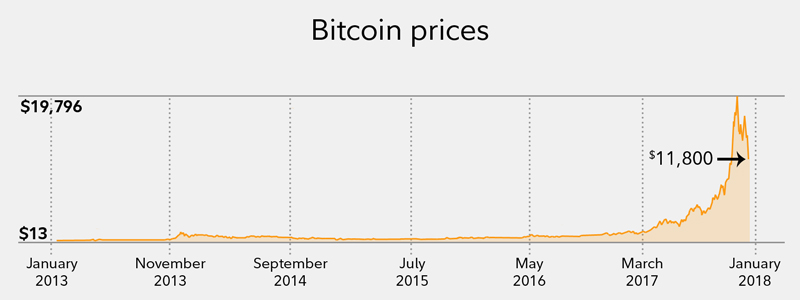
Here are some answers to frequently asked questions:
What is Bitcoin?
Bitcoin is the first and largest asset in the growing category of cryptocurrency (also known as digital currency). It was originally intended as a medium of exchange that is created and held electronically. There are hundreds of digital currencies, which have a market capitalization of over $500 billion (as of mid-January 2018).*
We'll focus on Bitcoin here to illustrate how digital currencies work. However, the underlying blockchain technology and functionality of Bitcoin are similar to many of the other widely used digital currencies, including Ethereum, Bitcoin Cash, and Litecoin. (For more on blockchain, see below.)
Who creates Bitcoin?
Bitcoins aren't printed by a government organization like the US Treasury does with dollars. Instead, they're produced by people and businesses running computers all around the world, using software that solves a very complex mathematical problem. The mathematical formula is freely available, so that anyone can check it, but you'll need a really powerful set of computers to solve the problem.
Who controls Bitcoin?
One of the important points is that no single person, entity, or organization controls Bitcoin. The fact that Bitcoin is not controlled or administered by a large bank or government entity is part of its appeal for many—but that also makes it harder to understand.
Can I tell who owns Bitcoin?
Bitcoins are sometimes regarded as anonymous. They are stored in digital wallets—essentially electronic vaults—which can have public electronic addresses associated with them. But they aren't necessarily linked to names, home or business addresses, or other personally identifying information. What’s more, you don't need to give your real name or other personal information to make direct transactions on the Bitcoin blockchain; only the digital addresses of the Bitcoin wallets identify the buyer and seller.
How is the value of Bitcoin determined?
Digital currency functions differently from traditional money. The price of a Bitcoin is determined by the supply and demand on the exchanges where it trades, while the buying power of traditional money is influenced by factors such as central bank monetary policy, inflation, and foreign currency exchange rates.
How do you transact with Bitcoin?
Transactions with Bitcoin can be completed without intermediaries like banks or credit card companies. When you transact with Bitcoin, it is essentially a direct transfer between the sender and recipient of the Bitcoins. Transfers can be made online or through a smartphone app—similar to making an electronic transfer with traditional currency.
What are pluses and minuses of transacting with Bitcoin?
For many, the advantages of Bitcoin are fast, anonymous, transparent, and low-cost transactions. But the infrastructure and adoption by businesses to support these transactions is still in the very early stages. Proponents of digital currency think this ability to easily transfer value from person to person throughout the world will inevitably lead to an increase in the use of digital currencies. Alternatively, the hyper-volatility of value and uncertainty of regulation could discourage businesses from accepting digital currencies.
Can I buy cryptocurrencies at Fidelity?
Retail brokerage customers cannot buy or sell any cryptocurrencies at Fidelity. However, those who have a Coinbase digital currency account can arrange to view those balances on Fidelity.com. Although Bitcoin futures are now available for trading on the CBOE and CME, Fidelity does not currently have any plans to offer Bitcoin futures trading for its retail brokerage customers.
Are there costs or commissions to buy and sell Bitcoin?
Some users and holders of digital currencies, such as Bitcoin, have reported having to pay significant transaction-related fees. In most cases, customers who purchase, sell, or transfer Bitcoin will be charged transaction fees by the cryptocurrency exchange (note that there are many exchanges, brokers, and other intermediaries where transaction costs can vary widely), and potentially other fees, like network fees. Every Bitcoin transaction has a network fee that is automatically deducted from the Bitcoins sent, and the amount of the fee varies based on a variety of factors. In addition, consumers who use Bitcoin for financial transactions, or to purchase or sell goods, may also be charged fees.
What are some of the risks of investing in Bitcoin?
Some speculators have been drawn to Bitcoin trading as a way to make a quick profit. However, as is the case with most speculative investments, you need to be careful. Buying, selling, and using Bitcoins carry numerous risks. Among them:
- The price of Bitcoin and other digital currencies has fluctuated unpredictably and drastically. You could experience significant and rapid losses. Profits or losses from investing in Bitcoin are virtually impossible to predict.
- Digital currency such as Bitcoin is not legal tender. No law requires companies or individuals to accept Bitcoin as a form of payment. Instead, Bitcoin use is limited to businesses and individuals that are willing to accept Bitcoins.
- Platforms that buy and sell Bitcoins may be unregulated, can be hacked, may stop operating, and some have failed. In addition, like the platforms themselves, digital wallets can be hacked. As a result, consumers can—and have—lost money.
- Bitcoin transactions can be subject to fraud and theft. For example, a fraudster could pose as a Bitcoin exchange, Bitcoin intermediary, or trader in an effort to lure you to send money, which is then stolen.
- Unlike banking institutions that can provide FDIC insurance, there are no such safeguards provided to digital wallets.
- Bitcoin payments are irreversible. Once you complete a transaction, it cannot be reversed. Reversing a transaction depends solely on the willingness of the recipient to do so.
When researching and evaluating a potential investment, investors must decide for themselves whether the investment fits with their time horizon, financial circumstances, tolerance and preference for volatility, and risk of loss. Anyone thinking of investing in Bitcoin or in Bitcoin-related investment opportunities should do their research, be prepared for significant price gyrations, and proceed with caution.
Have regulators issued any statements on Bitcoin?
Cryptocurrencies have been on regulators' radar for some time. A number of federal and state regulators have issued investor alerts and other statements about Bitcoin, token sales or initial coin offerings (ICOs), and other cryptocurrency-related investments. The Securities and Exchange Commission (SEC) also recently suspended trading in a number of securities due to questions regarding the accuracy of these companies’ claims of cryptocurrency‐related activities. Right now, the laws and regulations are still developing and it is difficult to predict the eventual legal landscape for digital currencies.
What is blockchain?
Much of the media coverage of digital currency has focused on the fluctuating value of Bitcoin. But what you may not be hearing about is the disruptive power of the technology behind cryptocurrencies, which could have the true staying power. Bitcoin stores details of every single transaction that ever happened in a gigantic general ledger called the blockchain, which is distributed across the internet to all the computers that produce Bitcoin.
There are many more potential applications of blockchain technology. It is essentially a database that does not store information at a single computer server or physical location, compared with traditional information databases. Instead, a blockchain is hosted by all of the computers across the network that store the information. This allows for publicly available and readily verifiable information.
Fidelity sees several potential ways that blockchain technology could be impactful:
- Future developments in blockchain could alter financial markets in the same way that the internet did. Just as the internet made sending letters and other information more efficient, blockchain could change the market structure of currencies and perhaps even some aspects of the architecture of the internet itself.
- Blockchain technology has the potential to complement other emerging technologies—including the Internet of Things and artificial intelligence—creating new industries and financial products.
- As blockchain technology evolves, it may provide consumers greater access to some financial services and could give customers more control over their financial data.
Next steps to consider
Find new investing ideas and get up-to-the-minute market data.
Bitcoin plunges after SEC seeks to rein in cryptocurrencies

Cryptocurrencies have been on a wild ride and the Securities and Exchange Commission is trying to rein them in once and for all.
The SEC warned on Wednesday of "potentially unlawful online platforms for trading digital assets." The federal agency said that cryptocurrency traders should only buy and sell them on exchanges registered with the SEC.
"If a platform offers trading of digital assets that are securities and operates as an 'exchange,' as defined by the federal securities laws, then the platform must register with the SEC as a national securities exchange or be exempt from registration," said the SEC.
The announcement sent Bitcoin, the most well-known and highly-priced cryptocurrency, on a tailspin, dipping 9% to below $10,000, about half the value it was trading at last year, according to Coindesk.com. Ethereum and Litecoin also made significant declines.
Cryptocurrency is a digital currency that uses a technology called blockchain. The SEC said that many cryptocurrencies, and also coins and tokens offered through a fundraising method known as an Initial Coin Offering, meet the government's definition of a security. Trading platforms for cryptocurrencies are therefore subject to federal regulations and must be registered with the SEC.
This could really shake up the market, according to Todd Kornfeld, a financial services attorney at Pepper Hamilton.
"Liquidity is important for many holders of tokens, coins and cryptocurrencies, and if this SEC activity reduces access to the existing token, coin and cryptocurrency markets, that could result in increased volatility in the trading and pricing of tokens, coins and cryptocurrencies," Kornfeld said.
The SEC also warned that some of the unregistered, and therefore illegal, online trading platforms can appear to be legitimate.
"The SEC staff has concerns that many online trading platforms appear to investors as SEC-registered and regulated marketplaces when they are not," said the SEC. "Many platforms refer to themselves as 'exchanges,' which can give the misimpression to investors that they are regulated or meet the regulatory standards of a national securities exchange."
But the volatility and the SEC scrutiny shouldn't come as a surprise to those scrutinizing these markets, said Kornfeld. The SEC warned investors last year to be on the lookout for "potential scams" involving ICOs. It busted "pump and dump" schemes, in which alleged fraudsters lure investors, take their money, and run.
"It's not surprising that this has happened," said Kornfeld. "It's a logical conclusion."
Bitcoin may be down 40% this year but crypto developers are still fetching $1 million bonuses

 @floydmayweather
- Bitcoin may be down 40% year-to-date, but crypto developers are making out like bandits.
- Some firms are offering crypto talent $1 million dollar signing bonuses, according to a Wall Street Journal report.
Bitcoin may be down close to 40% since the beginning of the year, but that doesn't mean developers with expertise in the technology powering the crypto aren't making money hand-over-fist.
A Wall Street Journal report found that companies are willing to pay a lot to lure crypto talent. Some are even offering new hires $1 million dollar signing bonuses, according to Dave Schwartz, the chief cryptographer at Ripple, who told The Journal pay packages "have gotten insane."
Juha Mikkola, co-founder of Wyncode Academy, a coding school, told Business Insider he knows of developers being paid double the going-rate for their blockchain experience.
"It's not just tech companies that need this talent, it's real-estate, non-profits, and banks," Mikkola said in an interview.
The number of blockchain or cryptocurrency job postings on LinkedIn increased at least fourfold in 2017, Bloomberg News noted. Still such talent is in short supply, according to Miha Grcar, the head of business development for Bitstamp, a crypto exchange. He said the talent shortage is a bigger headache than bitcoin's volatility.
"Globally, the pool of talent — people with experience in blockchain and distributed-ledger technology — is somewhat limited," Grcar said. "This is a big challenge."


Комментариев нет:
Отправить комментарий