One more step
Please complete the security check to access bitcoinexchangeguide.com
Why do I have to complete a CAPTCHA?
Completing the CAPTCHA proves you are a human and gives you temporary access to the web property.
What can I do to prevent this in the future?
If you are on a personal connection, like at home, you can run an anti-virus scan on your device to make sure it is not infected with malware.
If you are at an office or shared network, you can ask the network administrator to run a scan across the network looking for misconfigured or infected devices.
Another way to prevent getting this page in the future is to use Privacy Pass. Check out the browser extension in the Firefox Add-ons Store.
Cloudflare Ray ID: 422a794ad17c8ef1 • Your IP : 185.87.51.142 • Performance & security by Cloudflare
Is Bitcoin Mining Profitable in 2018?
Last updated on February 26th, 2018 at 03:20 pm
Before we start, if you’re new to Bitcoin mining and don’t know what it is watch this short and simple explanation:
“Is Bitcoin Mining Profitable in 2018?“
The short answer would be “It depends on how much you’re willing to spend”. Each person asking himself this will get a slightly different answer since Bitcoin Mining profitability depends on many different factors. In order to find out Bitcoin mining profitability for different factors “mining profitability calculators” were invented.
These calculators take into account the different parameters such as electricity cost, the cost of your hardware and other variables and give you an estimate of your projected profit. Before I give you a short example of how this is calculated let’s make sure you are familiar with the different variables:
Bitcoin Mining terms you should get to know
Hash Rate – A Hash is the mathematical problem the miner’s computer needs to solve. The Hash Rate is the rate at which these problems are being solved. The more miners that join the Bitcoin network, the higher the network Hash Rate is.
The Hash Rate can also refer to your miner’s performance. Today Bitcoin miners (those super powerful computers talked about in the video) come with different Hash Rates. Miners’ performance is measured in MH/s (Mega hash per second), GH/s (Giga hash per second), TH/s (Terra hash per second) and even PH/s (Peta hash per second).
Bitcoins per Block – Each time a mathematical problem is solved, a constant amount of Bitcoins are created. The number of Bitcoins generated per block starts at 50 and is halved every 210,000 blocks (about four years). The current number of Bitcoins awarded per block is 12.5. The last block halving occurred on July 2016 and the next one will be in 2020.
Bitcoin Difficulty – Since the Bitcoin network is designed to produce a constant amount of Bitcoins every 10 minutes, the difficulty of solving the mathematical problems has to increase in order to adjust to the network’s Hash Rate increase. Basically this means that the more miners that join, the harder it gets to actually mine Bitcoins.
Electricity Rate – Operating a Bitcoin miner consumes a lot of electricity. You’ll need to find out your electricity rate in order to calculate profitability. This can usually be found on your monthly electricity bill.
Power consumption – Each miner consumes a different amount of energy. Make sure to find out the exact power consumption of your miner before calculating profitability. This can be found easily with a quick search on the Internet or through this list. Power consumption is measured in Watts.
Pool fees – In order to mine you’ll need to join a mining pool. A mining pool is a group of miners that join together in order to mine more effectively. The platform that brings them together is called a mining pool and it deducts some sort of a fee in order to maintain its operations. Once the pool manages to mine Bitcoins the profits are divided between the pool members depending on how much work each miner has done (i.e. their miner’s hash rate).
Time Frame – When calculating if Bitcoin mining is profitable you’ll have to define a time frame to relate to. Since the more time you mine, the more Bitcoins you’ll earn.
Profitability decline per year – This is probably the most important and elusive variable of them all. The idea is that since no one can actually predict the rate of miners joining the network no one can also predict how difficult it will be to mine in 6 weeks, 6 months or 6 years from now. This is one of the two reasons no one will ever be able to answer you once and for all “is Bitcoin mining profitable ?”. The second reason is the conversion rate. In the case below, you can insert an annual profitability decline factor that will help you estimate the growing difficulty.
Conversion rate – Since no one knows what the BTC/USD exchange rate will be in the future it’s hard to predict if Bitcoin mining will be profitable. If you’re into mining in order to accumulate Bitcoins only then this doesn’t need to bother you. But if you are planning to convert these Bitcoins in the future to any other currency this factor will have a major impact of course.
Get a mining calculator
In order to calculate all of these parameters and get an answer to our question we will use a mining profitability calculator. here’s a simple mining calculator from 99Bitcoins:
Beginner’s Guide to Mining Bitcoins
Last updated on May 18th, 2018 at 03:08 pm
One of the biggest problems I ran into when I was looking to start mining Bitcoin for investment and profit was most of the sites were written for the advanced user. I am not a professional coder, I have no experience with Ubuntu, Linux and minimal experience with Mac. So, this is for the individual or group that wants to get started the easy way.
1. Get a Bitcoin mining rig
Bitcoin mining is a very competitive niche to get into. As more and more miners come on board with the latest mining hardware the difficulty to mine increases each day. Before even starting out with Bitcoin mining you need to do your due diligence. This means you need to find out if Bitcoin mining is even profitable for you.
The best way to do this is through the use of a Bitcoin mining calculator. Just enter the data of the Bitcoin miner you are planning on buying and see how long it will take you to break even or make a profit. However, I can tell you from the get go that if you don’t have a few hundred dollars to spare you probably won’t be able to mine any Bitcoins.
Once you’ve finished with your calculations it’s time to get your miner. Make sure to go over our different Bitcoin mining hardware reviews to understand which miner is best for you. Today, the Antminer S9 is the newest and most powerful miner.
Select miner
AntMiner S9
Antminer R4
Antminer T9
AntMiner S7
AntMiner S5
Antrouter R1
As a side note it’s important to state that in the past it was possible to mine Bitcoins with your computer or with a graphics card (also known as GPU mining). Today however, the mining niche has become so competitive that you’ll need to use ASIC miners – special computers built strictly for mining Bitcoins.
2. Get a Bitcoin wallet
First thing you need to do is get a “Bitcoin Wallet“. Because Bitcoin is an internet based currency, you need a place to keep your Bitcoins. Once you have a wallet make sure to get your wallet address. It will be a long sequence of letters and numbers. Each wallet has a different way to get the public Bitcoin address but most wallets are pretty straight forward about it. Notice that you’ll need your PUBLIC bitcoin address and not your PRIVATE KEY (which is like a password for your wallet).
If you’re using a self hosted wallet (i.e. you downloaded a program to your computer and are not using an internet based service) there’s one additional very important step. Make sure you have a copy of the wallet.dat file on a thumb drive and print a copy out and keep it in a safe location. You can view a tutorial on how to create a secure wallet here. The reason is that if you computer crashes and you do not have a copy of your wallet.dat file, you will lose all of your Bitcoins. They won’t go to someone else, they will disappear forever. It is like burning cash.
3. Find a mining pool
Now that you have a wallet you are probably roaring to go, but if you actually want to make Bitcoin (money), you probably need to join a mining pool. A mining pool is a group of Bitcoin miners that combines their computing power to make more Bitcoins. The reason you shouldn’t go it alone is that Bitcoins are awarded in blocks, usually 12.5 at a time, and unless you get extremely lucky, you will not be getting any of those coins.
In a pool, you are given smaller and easier algorithms to solve and all of your combined work will make you more likely to solve the bigger algorithm and earn Bitcoins that are spread out throughout the pool based on your contribution. Basically, you will make a more consistent amount of Bitcoins and will be more likely to receive a good return on your investment.
When choosing which mining pool to join you will need to ask several questions:
- What is the reward method? – Proportional/Pay Per Share/Score Based/PPLNS
- What fee they charge for mining and withdrawal of funds?
- How frequently they find a block (means how frequently I get rewarded)?
- How easy it is to withdraw funds?
- What kind of stats they provide?
- How stable is the pool?
To answer most of these questions you can use our best Bitcoin mining pools review or this excellent post from BitcoinTalk. You can also find a complete comparison of mining pools inside the Bitcoin wiki. For the purpose of demonstration I will use Slush’s Pool when mining for Bitcoins. Once you are signed up with a pool you will get a username and password for that specific pool which we will use later on.
Follow the link to go to their site and click the “Sign up here” link at the top of their site and follow their step by step instructions. After you have your account set up, you will need to add a “Worker”. Basically, for every miner that you have running, you will need to have a worker ID so the pool can keep track of your contributions.
4. Get a mining program for your computer
Now that you’ve got the basics covered we’re almost ready to mine. You will need a mining client to run on your computer to that you will be able to control and monitor your mining rig. Depending on what mining rig you got you will need to find the right software. Many mining pools have their own software but some don’t. You can find a list of Bitcoin mining software here.
I’m using a mac so I will use a program called MacMiner. The most popular program I’ve found for a PC are BFGMiner and 50Miner . If you want to compare different mining software you can do this here.
5. Start mining
OK, so hopefully now everything is ready to go. Connect you miner to a power outlet and fire it up. Make sure to connect it also to your computer (usually via USB) and open up your mining software. The first thing you’ll need to do is to enter your mining pool, username and password.
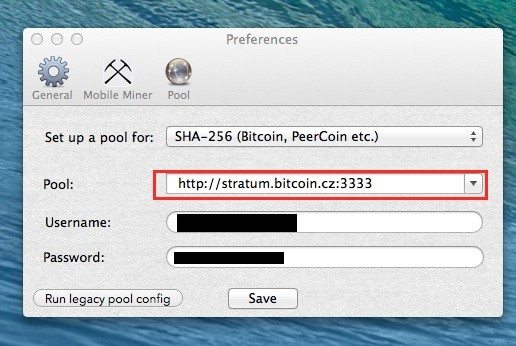
Once this is configured you’ll basically start mining for Bitcoins. You will actually start collections shares which represent your part of the work in finding the next block. According to the pool you’ve chosen you will be paid for your share of coins – just make sure that you enter your address in the required fields when signing up to the pool. Here’s a full video of me mining in action:
Conclusion – perhaps it’s better just to buy the coins?
To conclude this article here’s something to consider. Perhaps it would be more profitable for you to just buy Bitcoins with the money you plan to spend on Bitcoin mining. Many times just buying the coins will yield a higher ROI (return on investment) than mining. If you want to dig into this a bit deeper here’s a post about exactly that.
What is Bitcoin Mining?
Bitcoin Mining Hardware Comparison
Currently, based on (1) price per hash and (2) electrical efficiency the best Bitcoin miner options are:
AntRouter R1
Antminer S9
BPMC Red Fury USB
- Overview - Table of Contents
- What is Bitcoin Mining?
- Technical Background
- Bitcoin Mining Hardware
- Bitcoin Mining Software
- Bitcoin Cloud Mining
- Mining Infographic
- What is Proof of Work?
- What is Bitcoin Mining Difficulty?
- Other Languages
Before we begin.
Before you read further, please understand that most bitcoin users don't mine! But if you do then this Bitcoin miner is probably the best deal. Bitcoin mining for profit is very competitive and volatility in the Bitcoin price makes it difficult to realize monetary gains without also speculating on the price. Mining makes sense if you plan to do it for fun, to learn or to support the security of Bitcoin and do not care if you make a profit. If you have access to large amounts of cheap electricity and the ability to manage a large installation and business, you can mine for a profit.
If you want to get bitcoins based on a fixed amount of mining power, but you don't want to run the actual hardware yourself, you can purchase a mining contract.
Another tool many people like to buy is a Bitcoin debit card which enables people to load a debit card with funds via bitcoins.
What is Bitcoin mining?
Bitcoin mining is a lot like a giant lottery where you compete with your mining hardware with everyone on the network to earn bitcoins. Faster Bitcoin mining hardware is able to attempt more tries per second to win this lottery while the Bitcoin network itself adjusts roughly every two weeks to keep the rate of finding a winning block hash to every ten minutes. In the big picture, Bitcoin mining secures transactions that are recorded in Bitcon's public ledger, the block chain. By conducting a random lottery where electricity and specialized equipment are the price of admission, the cost to disrupt the Bitcoin network scales with the amount of hashing power that is being spent by all mining participants.
Technical Background
During mining, your Bitcoin mining hardware runs a cryptographic hashing function (two rounds of SHA256) on what is called a block header. For each new hash that is tried, the mining software will use a different number as the random element of the block header, this number is called the nonce. Depending on the nonce and what else is in the block the hashing function will yield a hash which looks something like this:
You can look at this hash as a really long number. (It's a hexadecimal number, meaning the letters A-F are the digits 10-15.) To ensure that blocks are found roughly every ten minutes, there is what's called a difficulty target. To create a valid block your miner has to find a hash that is below the difficulty target. So if for example the difficulty target is
any number that starts with a zero would be below the target, e.g.:
If we lower the target to
we now need two zeros in the beginning to be under it:
Because the target is such an unwieldy number with tons of digits, people generally use a simpler number to express the current target. This number is called the mining difficulty. The mining difficulty expresses how much harder the current block is to generate compared to the first block. So a difficulty of 70000 means to generate the current block you have to do 70000 times more work than Satoshi Nakamoto had to do generating the first block. To be fair, back then mining hardware and algorithms were a lot slower and less optimized.
To keep blocks coming roughly every 10 minutes, the difficulty is adjusted using a shared formula every 2016 blocks. The network tries to change it such that 2016 blocks at the current global network processing power take about 14 days. That's why, when the network power rises, the difficulty rises as well.
Bitcoin Mining Hardware
In the beginning, mining with a CPU was the only way to mine bitcoins and was done using the original Satoshi client. In the quest to further secure the network and earn more bitcoins, miners innovated on many fronts and for years now, CPU mining has been relatively futile. You might mine for decades using your laptop without earning a single coin.
About a year and a half after the network started, it was discovered that high end graphics cards were much more efficient at bitcoin mining and the landscape changed. CPU bitcoin mining gave way to the GPU (Graphical Processing Unit). The massively parallel nature of some GPUs allowed for a 50x to 100x increase in bitcoin mining power while using far less power per unit of work.
While any modern GPU can be used to mine, the AMD line of GPU architecture turned out to be far superior to the nVidia architecture for mining bitcoins and the ATI Radeon HD 5870 turned out to be the most cost effective choice at the time.
As with the CPU to GPU transition, the bitcoin mining world progressed up the technology food chain to the Field Programmable Gate Array. With the successful launch of the Butterfly Labs FPGA 'Single', the bitcoin mining hardware landscape gave way to specially manufactured hardware dedicated to mining bitcoins.
While the FPGAs didn't enjoy a 50x - 100x increase in mining speed as was seen with the transition from CPUs to GPUs, they provided a benefit through power efficiency and ease of use. A typical 600 MH/s graphics card consumed upwards of 400w of power, whereas a typical FPGA mining device would provide a hashrate of 826 MH/s at 80w of power.
That 5x improvement allowed the first large bitcoin mining farms to be constructed at an operational profit. The bitcoin mining industry was born.
The bitcoin mining world is now solidly in the Application Specific Integrated Circuit (ASIC) era. An ASIC is a chip designed specifically to do one thing and one thing only. Unlike FPGAs, an ASIC cannot be repurposed to perform other tasks.
An ASIC designed to mine bitcoins can only mine bitcoins and will only ever mine bitcoins. The inflexibility of an ASIC is offset by the fact that it offers a 100x increase in hashing power while reducing power consumption compared to all the previous technologies.
Unlike all the previous generations of hardware preceding ASIC, ASIC may be the "end of the line" when it comes to disruptive mining technology. CPUs were replaced by GPUs which were in turn replaced by FPGAs which were replaced by ASICs. There is nothing to replace ASICs now or even in the immediate future.
There will be stepwise refinement of the ASIC products and increases in efficiency, but nothing will offer the 50x to 100x increase in hashing power or 7x reduction in power usage that moves from previous technologies offered. This makes power consumption on an ASIC device the single most important factor of any ASIC product, as the expected useful lifetime of an ASIC mining device is longer than the entire history of bitcoin mining.
It is conceivable that an ASIC device purchased today would still be mining in two years if the device is power efficient enough and the cost of electricity does not exceed it's output. Mining profitability is also dictated by the exchange rate, but under all circumstances the more power efficient the mining device, the more profitable it is. If you want to try your luck at bitcoin mining then this Bitcoin miner is probably the best deal.
Bitcoin Mining Software
There are two basic ways to mine: On your own or as part of a Bitcoin mining pool or with Bitcoin cloud mining contracts and be sure to avoid Bitcoin cloud mining scams. Almost all miners choose to mine in a pool because it smooths out the luck inherent in the Bitcoin mining process. Before you join a pool, make sure you have a bitcoin wallet so you have a place to store your bitcoins. Next you will need to join a mining pool and set your miner(s) to connect to that pool. With pool mining, the profit from each block any pool member generates is divided up among the members of the pool according to the amount of hashes they contributed.
How much bandwidth does Bitcoin mining take? If you are using a bitcoin miner for mining with a pool then the amount should be negligible with about 10MB/day. However, what you do need is exceptional connectivity so that you get any updates on the work as fast as possible.
This gives the pool members a more frequent, steady payout (this is called reducing your variance), but your payout(s) can be decreased by whatever fee the pool might charge. Solo mining will give you large, infrequent payouts and pooled mining will give you small, frequent payouts, but both add up to the same amount if you're using a zero fee pool in the long-term.
Bitcoin Cloud Mining
By purchasing Bitcoin cloud mining contracts, investors can earn Bitcoins without dealing with the hassles of mining hardware, software, electricity, bandwidth or other offline issues.
Being listed in this section is NOT an endorsement of these services and is to serve merely as a Bitcoin cloud mining comparison. There have been a tremendous amount of Bitcoin cloud mining scams.
Hashflare Review: Hashflare offers SHA-256 mining contracts and more profitable SHA-256 coins can be mined while automatic payouts are still in BTC. Customers must purchase at least 10 GH/s.
Genesis Mining Review: Genesis Mining is the largest Bitcoin and scrypt cloud mining provider. Genesis Mining offers three Bitcoin cloud mining plans that are reasonably priced. Zcash mining contracts are also available.
Hashing 24 Review: Hashing24 has been involved with Bitcoin mining since 2012. They have facilities in Iceland and Georgia. They use modern ASIC chips from BitFury deliver the maximum performance and efficiency possible.
What is Bitcoin Mining?
Bitcoin mining is the process of adding transaction records to Bitcoin's public ledger of past transactions. This ledger of past transactions is called the block chain as it is a chain of blocks. The block chain serves to confirm transactions to the rest of the network as having taken place.
Bitcoin nodes use the block chain to distinguish legitimate Bitcoin transactions from attempts to re-spend coins that have already been spent elsewhere.
Bitcoin mining is intentionally designed to be resource-intensive and difficult so that the number of blocks found each day by miners remains steady. Individual blocks must contain a proof of work to be considered valid. This proof of work is verified by other Bitcoin nodes each time they receive a block. Bitcoin uses the hashcash proof-of-work function.
The primary purpose of mining is to allow Bitcoin nodes to reach a secure, tamper-resistant consensus. Mining is also the mechanism used to introduce Bitcoins into the system: Miners are paid any transaction fees as well as a "subsidy" of newly created coins.
This both serves the purpose of disseminating new coins in a decentralized manner as well as motivating people to provide security for the system.
Bitcoin mining is so called because it resembles the mining of other commodities: it requires exertion and it slowly makes new currency available at a rate that resembles the rate at which commodities like gold are mined from the ground.
What is Proof of Work?
A proof of work is a piece of data which was difficult (costly, time-consuming) to produce so as to satisfy certain requirements. It must be trivial to check whether data satisfies said requirements.
Producing a proof of work can be a random process with low probability, so that a lot of trial and error is required on average before a valid proof of work is generated. Bitcoin uses the Hashcash proof of work.
What is Bitcoin Mining Difficulty?
The Computationally-Difficult Problem
Bitcoin mining a block is difficult because the SHA-256 hash of a block's header must be lower than or equal to the target in order for the block to be accepted by the network.
This problem can be simplified for explanation purposes: The hash of a block must start with a certain number of zeros. The probability of calculating a hash that starts with many zeros is very low, therefore many attempts must be made. In order to generate a new hash each round, a nonce is incremented. See Proof of work for more information.
The Bitcoin Network Difficulty Metric
The Bitcoin mining network difficulty is the measure of how difficult it is to find a new block compared to the easiest it can ever be. It is recalculated every 2016 blocks to a value such that the previous 2016 blocks would have been generated in exactly two weeks had everyone been mining at this difficulty. This will yield, on average, one block every ten minutes.
As more miners join, the rate of block creation will go up. As the rate of block generation goes up, the difficulty rises to compensate which will push the rate of block creation back down. Any blocks released by malicious miners that do not meet the required difficulty target will simply be rejected by everyone on the network and thus will be worthless.
The Block Reward
When a block is discovered, the discoverer may award themselves a certain number of bitcoins, which is agreed-upon by everyone in the network. Currently this bounty is 25 bitcoins; this value will halve every 210,000 blocks. See Controlled Currency Supply or use a bitcoin mining calculator.
Additionally, the miner is awarded the fees paid by users sending transactions. The fee is an incentive for the miner to include the transaction in their block. In the future, as the number of new bitcoins miners are allowed to create in each block dwindles, the fees will make up a much more important percentage of mining income.
Blitzboom and the guys from #bitcoin-dev for their help with writing the guide!
How Bitcoin Mining Works
Last updated: 29th January 2018
When you hear about bitcoin "mining," you envisage coins being dug out of the ground. But bitcoin isn't physical, so why do we call it mining?
Because it's similar to gold mining in that the bitcoins exist in the protocol's design (just as the gold exists underground), but they haven't been brought out into the light yet (just as the gold hasn't yet been dug up). The bitcoin protocol stipulates that 21 million bitcoins will exist at some point. What "miners" do is bring them out into the light, a few at a time.
They get to do this as a reward for creating blocks of validated transactions and including them in the blockchain.

Backtracking a bit, let's talk about "nodes." A node is a powerful computer that runs the bitcoin software and helps to keep bitcoin running by participating in the relay of information. Anyone can run a node, you just download the bitcoin software (free) and leave a certain port open (the drawback is that it consumes energy and storage space – the network at time of writing takes up about 145GB). Nodes spread bitcoin transactions around the network. One node will send information to a few nodes that it knows, who will relay the information to nodes that they know, etc. That way it ends up getting around the whole network pretty quickly.
Some nodes are mining nodes (usually referred to as "miners"). These group outstanding transactions into blocks and add them to the blockchain. How do they do this? By solving a complex mathematical puzzle that is part of the bitcoin program, and including the answer in the block. The puzzle that needs solving is to find a number that, when combined with the data in the block and passed through a hash function, produces a result that is within a certain range. This is much harder than it sounds.
(For trivia lovers, this number is called a "nonce", which is a concatenation of "number used once." In the case of bitcoin, the nonce is an integer between 0 and 4,294,967,296 .)
Solving the puzzle
How do they find this number? By guessing at random. The hash function makes it impossible to predict what the output will be. So, miners guess the mystery number and apply the hash function to the combination of that guessed number and the data in the block. The resulting hash has to start with a pre-established number of zeroes. There's no way of knowing which number will work, because two consecutive integers will give wildly varying results. What's more, there may be several nonces that produce the desired result, or there may be none (in which case the miners keep trying, but with a different block configuration).
The first miner to get a resulting hash within the desired range announces its victory to the rest of the network. All the other miners immediately stop work on that block and start trying to figure out the mystery number for the next one. As a reward for its work, the victorious miner gets some new bitcoin.

At the time of writing, the reward is 12.5 bitcoins, which at time of writing is worth almost $200,000.
Although it's not nearly as cushy a deal as it sounds. There are a lot of mining nodes competing for that reward, and it is a question of luck and computing power (the more guessing calculations you can perform, the luckier you are).
Also, the costs of being a mining node are considerable, not only because of the powerful hardware needed (if you have a faster processor than your competitors, you have a better chance of finding the correct number before they do), but also because of the large amounts of electricity that running these processors consumes.
And, the number of bitcoins awarded as a reward for solving the puzzle will decrease. It's 12.5 now, but it halves every four years or so (the next one is expected in 2020-21). The value of bitcoin relative to cost of electricity and hardware could go up over the next few years to partially compensate this reduction, but it's not certain.
The difficulty of the calculation (the required number of zeroes at the beginning of the hash string) is adjusted frequently, so that it takes on average about 10 minutes to process a block.
Why 10 minutes? That is the amount of time that the bitcoin developers think is necessary for a steady and diminishing flow of new coins until the maximum number of 21 million is reached (expected some time in 2140).
If you've made it this far, then congratulations! There is still so much more to explain about the system, but at least now you have an idea of the broad outline of the genius of the programming and the concept. For the first time we have a system that allows for convenient digital transfers in a decentralized, trust-free and tamper-proof way. The repercussions could be huge.
Authored by Noelle Acheson. Bitcoin and bitcoin mining images via Shutterstock.
Introduction
Mining is the process of adding transaction records to Bitcoin's public ledger of past transactions (and a "mining rig" is a colloquial metaphor for a single computer system that performs the necessary computations for "mining". This ledger of past transactions is called the block chain as it is a chain of blocks. The blockchain serves to confirm transactions to the rest of the network as having taken place. Bitcoin nodes use the blockchain to distinguish legitimate Bitcoin transactions from attempts to re-spend coins that have already been spent elsewhere.
Mining is intentionally designed to be resource-intensive and difficult so that the number of blocks found each day by miners remains steady. Individual blocks must contain a proof of work to be considered valid. This proof of work is verified by other Bitcoin nodes each time they receive a block. Bitcoin uses the hashcash proof-of-work function.
The primary purpose of mining is to set the history of transactions in a way that is computationally impractical to modify by any one entity. By downloading and verifying the blockchain, bitcoin nodes are able to reach consensus about the ordering of events in bitcoin.
Mining is also the mechanism used to introduce Bitcoins into the system: Miners are paid any transaction fees as well as a "subsidy" of newly created coins. This both serves the purpose of disseminating new coins in a decentralized manner as well as motivating people to provide security for the system.
Bitcoin mining is so called because it resembles the mining of other commodities: it requires exertion and it slowly makes new units available to anybody who wishes to take part. An important difference is that the supply does not depend on the amount of mining. In general changing total miner hashpower does not change how many bitcoins are created over the long term.
Difficulty
The Computationally-Difficult Problem
Mining a block is difficult because the SHA-256 hash of a block's header must be lower than or equal to the target in order for the block to be accepted by the network. This problem can be simplified for explanation purposes: The hash of a block must start with a certain number of zeros. The probability of calculating a hash that starts with many zeros is very low, therefore many attempts must be made. In order to generate a new hash each round, a nonce is incremented. See Proof of work for more information.
The Difficulty Metric
The difficulty is the measure of how difficult it is to find a new block compared to the easiest it can ever be. The rate is recalculated every 2,016 blocks to a value such that the previous 2,016 blocks would have been generated in exactly one fortnight (two weeks) had everyone been mining at this difficulty. This is expected yield, on average, one block every ten minutes.
As more miners join, the rate of block creation increases. As the rate of block generation increases, the difficulty rises to compensate, which has a balancing of effect due to reducing the rate of block-creation. Any blocks released by malicious miners that do not meet the required difficulty target will simply be rejected by the other participants in the network.
When a block is discovered, the discoverer may award themselves a certain number of bitcoins, which is agreed-upon by everyone in the network. Currently this bounty is 12.5 bitcoins; this value will halve every 210,000 blocks. See Controlled Currency Supply.
Additionally, the miner is awarded the fees paid by users sending transactions. The fee is an incentive for the miner to include the transaction in their block. In the future, as the number of new bitcoins miners are allowed to create in each block dwindles, the fees will make up a much more important percentage of mining income.
The mining ecosystem
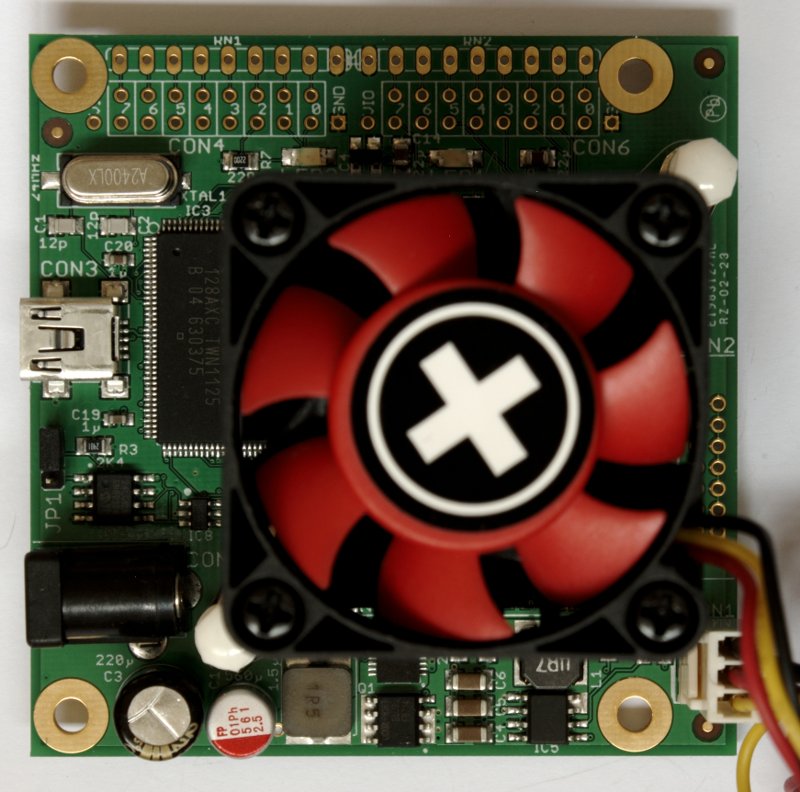
Users have used various types of hardware over time to mine blocks. Hardware specifications and performance statistics are detailed on the Mining Hardware Comparison page.
CPU Mining
Early Bitcoin client versions allowed users to use their CPUs to mine. The advent of GPU mining made CPU mining financially unwise as the hashrate of the network grew to such a degree that the amount of bitcoins produced by CPU mining became lower than the cost of power to operate a CPU. The option was therefore removed from the core Bitcoin client's user interface.
GPU Mining
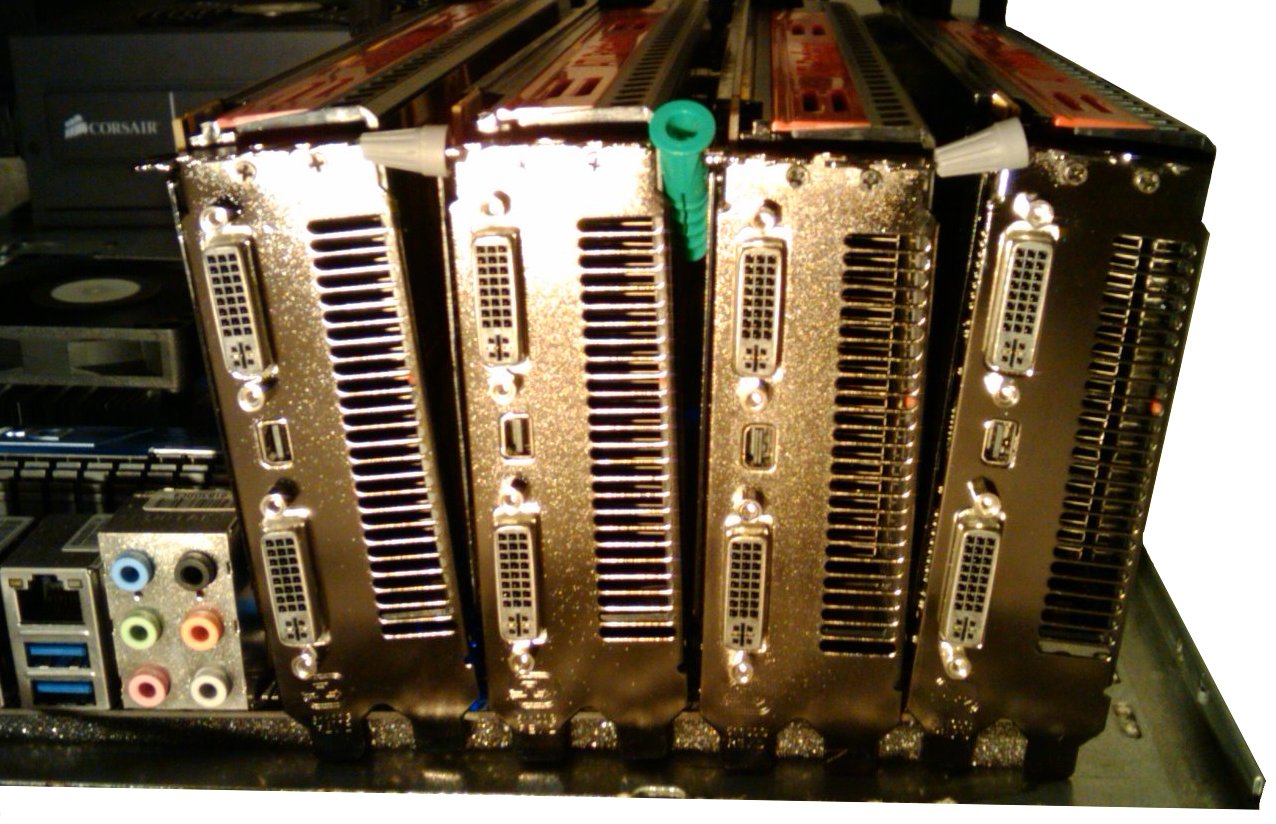
GPU Mining is drastically faster and more efficient than CPU mining. See the main article: Why a GPU mines faster than a CPU. A variety of popular mining rigs have been documented.
FPGA Mining
FPGA mining is a very efficient and fast way to mine, comparable to GPU mining and drastically outperforming CPU mining. FPGAs typically consume very small amounts of power with relatively high hash ratings, making them more viable and efficient than GPU mining. See Mining Hardware Comparison for FPGA hardware specifications and statistics.
ASIC Mining
An application-specific integrated circuit, or ASIC, is a microchip designed and manufactured for a very specific purpose. ASICs designed for Bitcoin mining were first released in 2013. For the amount of power they consume, they are vastly faster than all previous technologies and already have made GPU mining financially.
Mining services (Cloud mining)
Mining contractors provide mining services with performance specified by contract, often referred to as a "Mining Contract." They may, for example, rent out a specific level of mining capacity for a set price at a specific duration.
As more and more miners competed for the limited supply of blocks, individuals found that they were working for months without finding a block and receiving any reward for their mining efforts. This made mining something of a gamble. To address the variance in their income miners started organizing themselves into pools so that they could share rewards more evenly. See Pooled mining and Comparison of mining pools.
Bitcoin's public ledger (the "block chain") was started on January 3rd, 2009 at 18:15 UTC presumably by Satoshi Nakamoto. The first block is known as the genesis block. The first transaction recorded in the first block was a single transaction paying the reward of 50 new bitcoins to its creator.
Bitcoin minen
How Bitcoin Mining Works
Where do bitcoins come from? With paper money, a government decides when to print and distribute money. Bitcoin doesn't have a central government.
With Bitcoin, miners use special software to solve math problems and are issued a certain number of bitcoins in exchange. This provides a smart way to issue the currency and also creates an incentive for more people to mine.
Bitcoin is Secure
Bitcoin miners help keep the Bitcoin network secure by approving transactions. Mining is an important and integral part of Bitcoin that ensures fairness while keeping the Bitcoin network stable, safe and secure.
- We Use Coins - Learn all about crypto-currency.
- Bitcoin News - Where the Bitcoin community gets news.
- Bitcoin Knowledge Podcast - Interviews with top people in Bitcoin
Bitcoin Mining Hardware Comparison
Currently, based on (1) price per hash and (2) electrical efficiency the best Bitcoin miner options are:
AntMiner S7
AntMiner S9
- Overview - Table of Contents
- Mining Hardware Comparison
- What is Bitcoin Mining?
- What is the Blockchain?
- What is Proof of Work?
- What is Bitcoin Mining Difficulty?
- The Computationally-Difficult Problem
- The Bitcoin Network Difficulty Metric
- The Block Reward
Bitcoin mining is the process of adding transaction records to Bitcoin's public ledger of past transactions or blockchain. This ledger of past transactions is called the block chain as it is a chain of blocks. The block chain serves to confirm transactions to the rest of the network as having taken place.
Bitcoin nodes use the block chain to distinguish legitimate Bitcoin transactions from attempts to re-spend coins that have already been spent elsewhere.
What is Bitcoin Mining?
What is the Blockchain?
Bitcoin mining is intentionally designed to be resource-intensive and difficult so that the number of blocks found each day by miners remains steady. Individual blocks must contain a proof of work to be considered valid. This proof of work is verified by other Bitcoin nodes each time they receive a block. Bitcoin uses the hashcash proof-of-work function.
The primary purpose of mining is to allow Bitcoin nodes to reach a secure, tamper-resistant consensus. Mining is also the mechanism used to introduce Bitcoins into the system: Miners are paid any transaction fees as well as a "subsidy" of newly created coins.
This both serves the purpose of disseminating new coins in a decentralized manner as well as motivating people to provide security for the system.
Bitcoin mining is so called because it resembles the mining of other commodities: it requires exertion and it slowly makes new currency available at a rate that resembles the rate at which commodities like gold are mined from the ground.
What is Proof of Work?
A proof of work is a piece of data which was difficult (costly, time-consuming) to produce so as to satisfy certain requirements. It must be trivial to check whether data satisfies said requirements.
Producing a proof of work can be a random process with low probability, so that a lot of trial and error is required on average before a valid proof of work is generated. Bitcoin uses the Hashcash proof of work.
What is Bitcoin Mining Difficulty?
The Computationally-Difficult Problem
Bitcoin mining a block is difficult because the SHA-256 hash of a block's header must be lower than or equal to the target in order for the block to be accepted by the network.
This problem can be simplified for explanation purposes: The hash of a block must start with a certain number of zeros. The probability of calculating a hash that starts with many zeros is very low, therefore many attempts must be made. In order to generate a new hash each round, a nonce is incremented. See Proof of work for more information.
The Bitcoin Network Difficulty Metric
The Bitcoin mining network difficulty is the measure of how difficult it is to find a new block compared to the easiest it can ever be. It is recalculated every 2016 blocks to a value such that the previous 2016 blocks would have been generated in exactly two weeks had everyone been mining at this difficulty. This will yield, on average, one block every ten minutes.
As more miners join, the rate of block creation will go up. As the rate of block generation goes up, the difficulty rises to compensate which will push the rate of block creation back down. Any blocks released by malicious miners that do not meet the required difficulty target will simply be rejected by everyone on the network and thus will be worthless.
The Block Reward
When a block is discovered, the discoverer may award themselves a certain number of bitcoins, which is agreed-upon by everyone in the network. Currently this bounty is 25 bitcoins; this value will halve every 210,000 blocks. See Controlled Currency Supply.
Additionally, the miner is awarded the fees paid by users sending transactions. The fee is an incentive for the miner to include the transaction in their block. In the future, as the number of new bitcoins miners are allowed to create in each block dwindles, the fees will make up a much more important percentage of mining income.

Contribute and translate!
We want to spread knowledge about Bitcoin everywhere, do you think you can help us increase our content or translate for those who don't speak English?
Visit us on GitHub and learn how to contribute.
Bitcoin Mining
What is Bitcoin Mining?
Bitcoin Mining is a peer-to-peer computer process used to secure and verify bitcoin transactions—payments from one user to another on a decentralized network. Mining involves adding bitcoin transaction data to Bitcoin's global public ledger of past transactions. Each group of transactions is called a block. Blocks are secured by Bitcoin miners and build on top of each other forming a chain. This ledger of past transactions is called the blockchain. The blockchain serves to confirm transactions to the rest of the network as having taken place. Bitcoin nodes use the blockchain to distinguish legitimate Bitcoin transactions from attempts to re-spend coins that have already been spent elsewhere.
What is Proof-of-Work?
Bitcoin Mining is intentionally designed to be resource-intensive and difficult so that the number of blocks found each day by miners remains steady over time, producing a controlled finite monetary supply. Individual blocks must contain a proof-of-work to be considered valid. This proof-of-work (PoW) is verified by other Bitcoin nodes each time they receive a block. Bitcoin uses a PoW function to protect against double-spending, which also makes Bitcoin's ledger immutable.
How Does Mining Create New Bitcoins?
The primary purpose of mining is to allow Bitcoin nodes to reach a secure, tamper-resistant consensus. Mining is also the mechanism used to introduce bitcoins into the system. Miners are paid transaction fees as well as a subsidy of newly created coins, called block rewards. This both serves the purpose of disseminating new coins in a decentralized manner as well as motivating people to provide security for the system through mining.
What Are Bitcoin Mining Pools?
During the last several years an incredible amount of Bitcoin mining power (hashrate) has come online making it harder for individuals to have enough hashrate to single-handedly solve a block and earn the payout reward. To compensate for this pool mining was introduced. Pooled mining is a mining approach where groups of individual miners contribute to the generation of a block, and then split the block reward according the contributed processing power.
Bitcoin minen


BITCOIN MINING
Multimining is designed to be an online system used to allow any cryptocurrency enthusiast to buy hash power and begin reaping the benefits of bitcoin and altcoin mining. Once a user purchases one of the offered mining contracts, the user is entitled to immediately begin free cloud mining for their chosen coins. Just enter your address in the field below and then click on the start mining button and then see your balance growing while your computer works for you.
LITECOIN MINING
Multimining is designed to be an online system used to allow any cryptocurrency enthusiast to buy hash power and begin reaping the benefits of bitcoin and altcoin mining. Once a user purchases one of the offered mining contracts, the user is entitled to immediately begin free cloud mining for their chosen coins. Just enter your address in the field below and then click on the start mining button and then see your balance growing while your computer works for you.
ETHEREUM MINING
Multimining is designed to be an online system used to allow any cryptocurrency enthusiast to buy hash power and begin reaping the benefits of bitcoin and altcoin mining. Once a user purchases one of the offered mining contracts, the user is entitled to immediately begin free cloud mining for their chosen coins. Just enter your address in the field below and then click on the start mining button and then see your balance growing while your computer works for you.
Ref. Commission
Referral program is tiered in 3 levels 5%-2%-1%
Withdraw as little
as 0.01 coin Profit straight to your wallet.
Protected Servers
We use powerful dedicated servers and protected
Free Start Mining
Get power 30 GH/S (Lifetime) for new joining member.
YOUR PERSONAL CONNECTION TO A STRONGER FINANCIAL FUTURE
If you want to mine the latest crypto currencies and invest in an exploding market Multimining is a long term, secure and profitable investment program. One of the company's most prioritized activities is cryptocurrency and Altcoin Mining. Profits from this activity are used to enhance our program and increase its stability for the long term.
In order to discuss altcoin mining we need to first understand the difference between regular Bitcoin mining. As you may know, altcoi is a term referred to any cryptocurrency which isn’t Bitcoin. Some examples of altcoins include: Ethereum, Litecoin, Dash, and much much more. When we say “altcoin cloud mining” we mean a way of mining where you constantly switch the coin you are mining on a daily weekly or Monthly basis, unlike Bitcoin mining where you would continuously mine the same cryptocurrency.
The modern market is actively developing on the basis of Blockchain, which opens up wide opportunities for creating innovative solutions and autonomous, decentralized economic systems. In the digital age, crypto-economics takes one of the main roles, the introduction of a new business model that allows you to manage assets based on a completely new algorithm (SHA-256) or Scrypt algorithm.
How Bitcoin Mining Works
Last updated: 29th January 2018
When you hear about bitcoin "mining," you envisage coins being dug out of the ground. But bitcoin isn't physical, so why do we call it mining?
Because it's similar to gold mining in that the bitcoins exist in the protocol's design (just as the gold exists underground), but they haven't been brought out into the light yet (just as the gold hasn't yet been dug up). The bitcoin protocol stipulates that 21 million bitcoins will exist at some point. What "miners" do is bring them out into the light, a few at a time.
They get to do this as a reward for creating blocks of validated transactions and including them in the blockchain.
Backtracking a bit, let's talk about "nodes." A node is a powerful computer that runs the bitcoin software and helps to keep bitcoin running by participating in the relay of information. Anyone can run a node, you just download the bitcoin software (free) and leave a certain port open (the drawback is that it consumes energy and storage space – the network at time of writing takes up about 145GB). Nodes spread bitcoin transactions around the network. One node will send information to a few nodes that it knows, who will relay the information to nodes that they know, etc. That way it ends up getting around the whole network pretty quickly.
Some nodes are mining nodes (usually referred to as "miners"). These group outstanding transactions into blocks and add them to the blockchain. How do they do this? By solving a complex mathematical puzzle that is part of the bitcoin program, and including the answer in the block. The puzzle that needs solving is to find a number that, when combined with the data in the block and passed through a hash function, produces a result that is within a certain range. This is much harder than it sounds.
(For trivia lovers, this number is called a "nonce", which is a concatenation of "number used once." In the case of bitcoin, the nonce is an integer between 0 and 4,294,967,296 .)
Solving the puzzle
How do they find this number? By guessing at random. The hash function makes it impossible to predict what the output will be. So, miners guess the mystery number and apply the hash function to the combination of that guessed number and the data in the block. The resulting hash has to start with a pre-established number of zeroes. There's no way of knowing which number will work, because two consecutive integers will give wildly varying results. What's more, there may be several nonces that produce the desired result, or there may be none (in which case the miners keep trying, but with a different block configuration).
The first miner to get a resulting hash within the desired range announces its victory to the rest of the network. All the other miners immediately stop work on that block and start trying to figure out the mystery number for the next one. As a reward for its work, the victorious miner gets some new bitcoin.
At the time of writing, the reward is 12.5 bitcoins, which at time of writing is worth almost $200,000.
Although it's not nearly as cushy a deal as it sounds. There are a lot of mining nodes competing for that reward, and it is a question of luck and computing power (the more guessing calculations you can perform, the luckier you are).
Also, the costs of being a mining node are considerable, not only because of the powerful hardware needed (if you have a faster processor than your competitors, you have a better chance of finding the correct number before they do), but also because of the large amounts of electricity that running these processors consumes.
And, the number of bitcoins awarded as a reward for solving the puzzle will decrease. It's 12.5 now, but it halves every four years or so (the next one is expected in 2020-21). The value of bitcoin relative to cost of electricity and hardware could go up over the next few years to partially compensate this reduction, but it's not certain.
The difficulty of the calculation (the required number of zeroes at the beginning of the hash string) is adjusted frequently, so that it takes on average about 10 minutes to process a block.
Why 10 minutes? That is the amount of time that the bitcoin developers think is necessary for a steady and diminishing flow of new coins until the maximum number of 21 million is reached (expected some time in 2140).
If you've made it this far, then congratulations! There is still so much more to explain about the system, but at least now you have an idea of the broad outline of the genius of the programming and the concept. For the first time we have a system that allows for convenient digital transfers in a decentralized, trust-free and tamper-proof way. The repercussions could be huge.
Authored by Noelle Acheson. Bitcoin and bitcoin mining images via Shutterstock.


Комментариев нет:
Отправить комментарий